 Osaka City Guide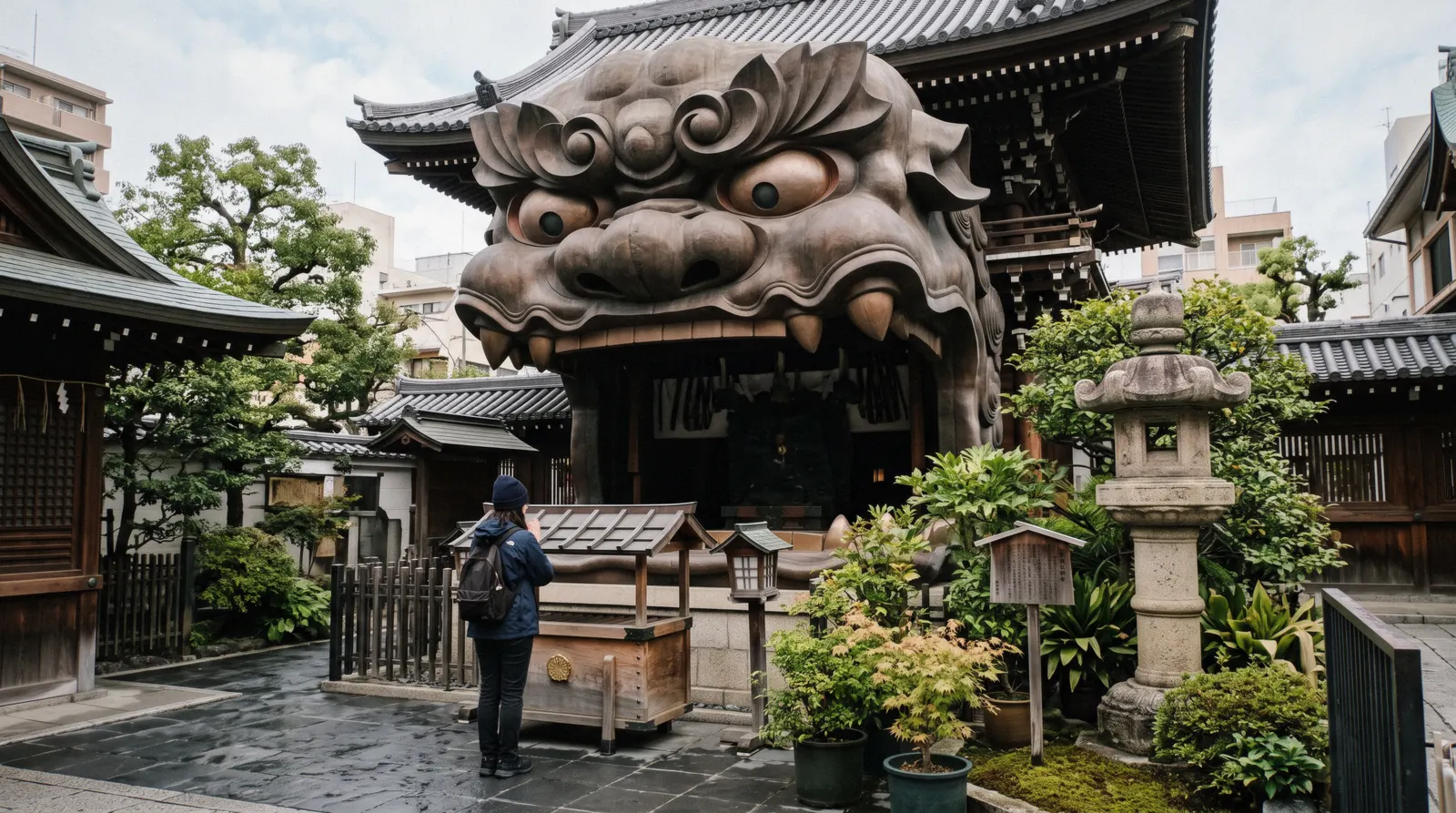
Namba Yasaka Shrine
Namba Yasaka Shrine is a small walled compound a few minutes west of the Namba crossings, and the reason anybody walks to it is a building shaped like an enormous lion's head with its jaws open. It is one of the most photographed objects in Osaka and one of the least documented. The shrine's own website publishes its deities, its two festivals, its sub-shrines, its wedding service, an address and a telephone number — and no opening hours, no admission statement, and, apart from a single passing phrase on the summer-festival page, nothing whatsoever about the lion. This page prints what the shrine itself states, marks clearly where the widely repeated figures came from, and gives you the number to ring instead of a schedule somebody invented. The rest of the city is covered in our guide to things to do in Osaka.
Quick answer No published hours, no published fee, one phone number
Namba Yasaka Shrine publishes no opening hours and no admission fee. We read the shrine's own site — the top page, the deities page, the two festival pages, the precinct page, the prayer page, the parish map and the access map — and the only visitor facts it states are the address, 2-9-19 Motomachi in Naniwa-ku, and the telephone number 06-6641-1149. No charge is taken at the gate. The hours you will find on every other site are somebody's observation, not a published timetable, so if your visit depends on the compound being open at a particular hour, the shrine's number is the only reliable answer.
Key takeaways
- The famous lion head gets one passing mention on the shrine's entire website — a phrase on the summer-festival page — and no dimensions, no build date and no name (what is published, and what is not)
- The two dates the shrine does publish are the tug-of-war rite on the third Sunday of January and the summer festival on 13 and 14 July — both are set out below
- It is a five-minute detour from Dotonbori, which is the honest way to plan it: a stop inside a Namba afternoon rather than a destination
- No operator sells a tour of this shrine; the private city walk that could route past it is three to seven hours and set by you
Key facts
Opening hours
| Not published by the shrine | not stated–not stated |
|---|---|
| Prayer and amulet office — by appointment, telephone 06-6641-1149 | not stated–not stated |
Closed Not published. The shrine's site lists no closed days, no seasonal hours and no New Year timetable
Admission
- Adult
- No admission fee published
- Reduced
- No admission fee published
- Free
- No entry charge is taken at the gate; the shrine publishes no fee of any kind for entry, and prices only its prayers, which are quoted on request
Planning it
- Time needed
- Not stated by the shrine; our routing: 15 to 20 minutes, and about 40 if you walk the five sub-shrines and wait for a clear photograph
- Address
- 2-9-19 Motomachi, Naniwa-ku, Osaka 556-0016 (shrine office 06-6641-1149, fax 06-6641-1182)
There is nothing to buy here, and this table sits where a ticket table normally would in order to say so. A page that skips the question is how visitors end up looking for a counter.
There is no counter here, so the question is not which ticket but whether you pay for anybody at all. Walking in is free, a prayer is quoted when you book, and the two guided walks start at $35.71.
| Option | What it costs | What it gets you | Book | Book |
|---|---|---|---|---|
| Walk in — the compound and the lion stageEveryone; the lion-head stage and five sub-shrines cost nothing to see | No admission fee published | The forecourt, the main hall of 1974, the lion-head stage and five sub-shrines | Nothing to book; no hours published either | Official site |
| A formal prayer, personal or corporateVisitors who want a rite in the main hall, arranged in advance by telephone | Not stated — quoted when you book | A rite in the main hall, arranged in advance at the office west of it | By telephone, 06-6641-1149 | Official site |
| Private city walking tour, 3 to 7 hoursThe only product whose route you set — ask for this shrine by name | From $35.71 | A guide and a route you agree — the only product whose itinerary you control | Free up to 24 hours before | Check Availability |
| Guided city walk with castle admission, 4 hoursA general city walk; this shrine is not among its listed stops | From $54.56 | Osaka Castle, Tsutenkaku and the Namba district; this shrine is not a listed stop | Free up to 24 hours before | Check Availability |
Shrine details were read on nambayasaka.jp in Q3 2026; tour prices are the platform's own USD listings, read the same day. The shrine's site does state one price-adjacent fact worth knowing: prayers and off-site rites are by appointment, and the office asks you to telephone once you have a date in mind, warning that auspicious days fill early. Everything else — the amulets, the goshuin, whether either is available on an ordinary weekday — is unpublished, and we are not going to guess it for you.
Guided walks that pass this way
The honest position first: none of the 44 GetYourGuide products in this site's Osaka inventory lists Namba Yasaka Shrine in its itinerary — we checked every one of them. That is not surprising for a fifteen-minute stop with no admission and no capacity for a group photograph. The cards below are the city's three general walking tours, and the reason they are here is the first one: it is private, three to seven hours, and its route is agreed with the guide, so it is the only product on the market that could be pointed at this shrine. The other two are fixed routes through Namba and the southern districts, shown so you can see what the guided market actually offers within a few minutes' walk of here. Prices are the platform's listings in USD.
 from $35.71
Osaka: Private or Group Hotspots & Hidden Gems Walking Tour
A three-hour walk that stretches to seven if you want it to, private or shared, with a takoyaki and a retro vending-machine drink included. The longer options use trains, which you pay for — usually under ¥1,000 a head.
Check Availability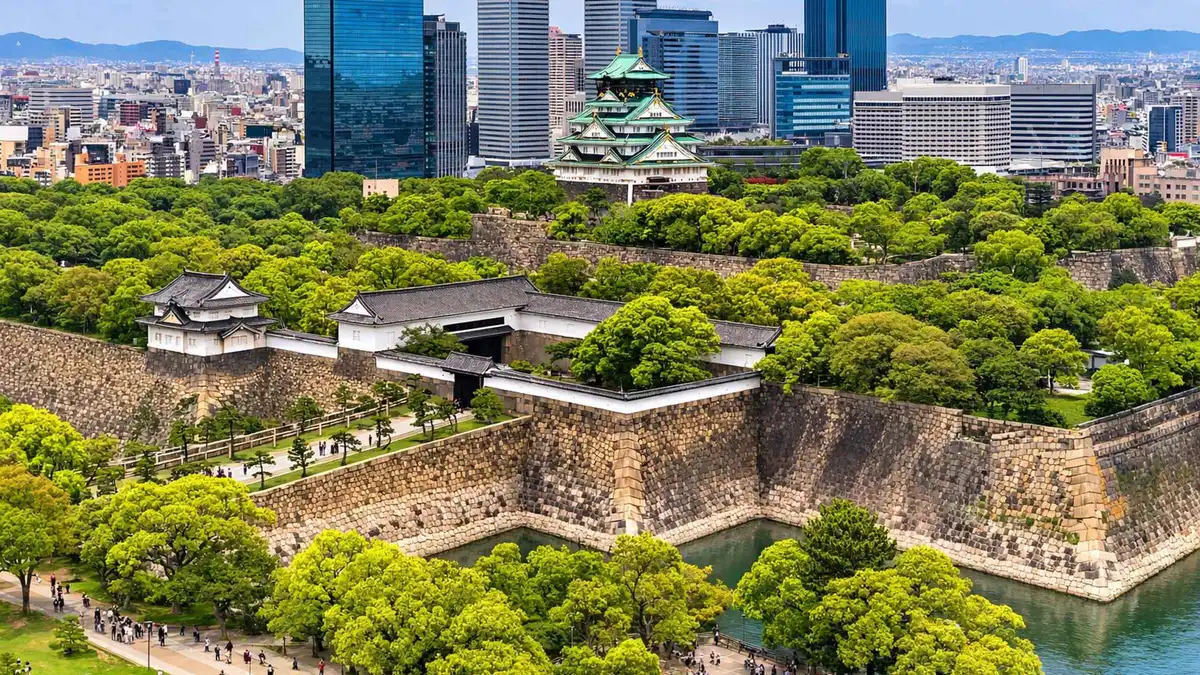 from $54.56
Osaka: Guided Walking Tour with a Native Expert – Top Sights
Four hours linking Osaka Castle, Tsutenkaku and Namba by metro, with the ¥1,200 keep admission included and the ¥430 of train fares not. A Japan Rail Pass buys you nothing here — the route runs on Osaka Metro.
Check Availability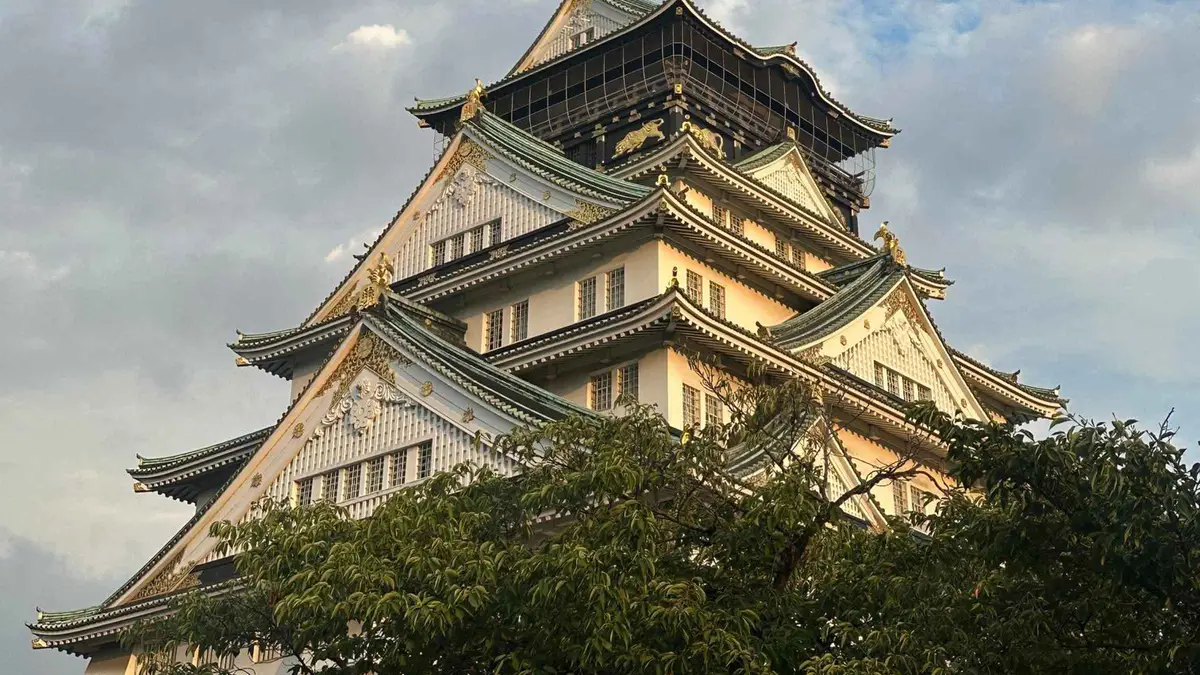 from $49.74
Osaka: Essential City Loop Tour with Local Guide
Five hours in a group of eight covering the castle, the Showa-era backstreets and the neon strip in one loop, with food bought stop by stop instead of a sit-down lunch. Only four people have rated it so far.
Check AvailabilityPrices, ratings and details are the platform's own. Dollar figures are the listed prices. The platform bills in your account's currency.
What the shrine actually documents about itself
It is a short list, and it is worth reading closely, because almost everything written about this place in English is downstream of these few paragraphs.
The shrine states on its own top page that no detailed record of its founding date survives. Its tradition holds that it was anciently called Namba Shimo-no-miya and served as the tutelary shrine of the whole Namba area, and that it was known from the Enkyu era — 1069 to 1073, in the reign of Emperor Go-Sanjo — as an old shrine to the Gion Gozu-Tenno. That is the earliest date the shrine will attach to itself, and it attaches it as a period of documented reputation rather than of foundation.
What followed is the standard shape of Japanese religious history in one compound. The site was syncretic, Buddhist and Shinto together, until the Meiji separation of the two; the temple that stood here was abolished and the shrine was ranked a gosha, a district shrine, in 1872. The buildings were destroyed in the air raids and fires of 1945 — that fact comes from the guidebook literature rather than from the shrine — and the main hall you see today was completed in May 1974. Every structure in the compound is post-war.
The deity, and a page that is a picture
The shrine's site has a page headed "Deities", and it contains no text at all: the content is a single image file, 645 by 1,900 pixels, with no alternative text. A search engine, a screen reader and a translation tool all see the same thing there, which is nothing. Simple English Wikipedia states the enshrined deity is Susanoo-no-Mikoto, which is consistent with the shrine's own description of itself as a Gion Gozu-Tenno shrine and with the myth its January rite re-enacts — but the shrine's own site never says the name in machine-readable form.
That is one small, precise example of why so much of what circulates about this place is other people's reconstruction.
Five sub-shrines, which the site does document
The precinct page lists them with their deities and their blessings: Sasayama Jinja, Inari Jinja, Sanbo-Kojin Jinja, Ichikishimahime Jinja and Kotai Jinja. Sasayama is the interesting one — it was founded on 26 December 1880 to honour Sasayama Jubei Kageyoshi, the Osaka deputy who from 1793 to 1809 backed the local villagers' petition to license a vegetable market at Namba, so that they no longer had to cart their produce across the city to Tenma to sell it. A shrine to a bureaucrat who cut a piece of red tape is a very Osaka thing to find behind a giant lion.
What is published, and by whom
Every line below was checked against the shrine's own site — the top page, the deities page, both festival pages, the precinct, prayer and access pages. Where the shrine says nothing, the table names who does.
| The question | The shrine's own site | Where the usual answer comes from | What this page prints |
|---|---|---|---|
| Opening hours | Nothing — no hours on any page | Travel blogs and aggregator listings, none citing a source | Not published; telephone 06-6641-1149 |
| Admission fee | Nothing — no fee statement of any kind | Blogs and videos calling it free entry | No fee published; no charge is taken at the gate |
| The lion-head stage | One phrase, on the summer-festival page, calling it the foremost lion stage in Japan | GaijinPot: 12 metres tall, 7 metres deep, built 1975. Japan Travel: 12 metres high, 11 metres wide, named Ema-Den | Both figures, attributed, with the disagreement shown |
| The enshrined deity | A page headed Deities containing only an image with no text | Simple English Wikipedia: Susanoo-no-Mikoto | Susanoo, attributed to Wikipedia and consistent with the shrine's Gion tradition |
| Festival dates | Published in full: third Sunday of January, and 13 and 14 July | Agrees | The shrine's own dates |
Two of those five rows are the shrine's own work and three are other people's. That ratio is the single most useful thing to understand before you plan around anything you read about this place — including this page, whose sources are named line by line so you can check them.
The lion head: what is claimed, and what can be verified
A twelve-metre lion with a stage in its mouth, and no official source for a single dimension of it. Here is the state of the evidence.
The structure stands on the west side of the compound facing the main hall, and it is a stage: the jaws form a proscenium, and performances are given from inside the mouth. The open mouth is popularly said to swallow evil spirits and draw in good fortune, which is why the visitors you see praying there tend to be students before examinations and businesspeople at the turn of the financial year.
The shrine mentions it exactly once. On its summer-festival page it writes that over the two days of the festival, lion dances and other performing arts are dedicated at "the foremost lion stage in Japan", along with a mochi-throwing rite. That phrase is the entire official record. There is no page about the building, no construction date, no dimensions, no name given for it and no photograph captioned on the shrine's site.
Everything else in circulation comes from travel media, and it does not agree with itself. GaijinPot Travel states that the stage was built in 1975 and stands 12 metres tall and 7 metres deep. Japan Travel calls the building Ema-Den and gives it as 12 metres high by 11 metres wide, describing it and the rest of the compound as post-war reconstructions after the 1945 raids. The height is the one figure both agree on; the second dimension differs by four metres and describes a different axis. Neither cites a source, and no measurement appears on any official page, in the shrine's own literature, or in the city's cultural-property listing, which covers the January rite rather than the building. The stage's tangled record makes it a natural stop on osaka guided tours, where the story of the lion head and its festival is told on site rather than pieced together from conflicting sources.
What to do with that, as a visitor
Nothing about the visit changes — you walk in and the lion is there, whatever its dimensions. What changes is what you should believe about the rest of the practical detail on the pages carrying those numbers. A site confident enough to publish a build year it cannot source is equally confident about opening hours it has not been given, and those hours are the thing that will actually cost you a wasted walk.
The compound is small, and if the inner gates are shut when you arrive the lion is still visible; there is no interior to miss.
Photographing it
The forecourt is narrow and the lion is wide, so the standard photograph is taken from close to the entrance with a wide lens, and it fills the frame from a couple of metres back. Later in the afternoon there is usually an informal queue for the position directly in front of the jaws; people take turns and it moves quickly. The eyes are lit after dark, which is when the building looks least like a monument and most like a fairground, and the compound sits in the middle of Osaka's busiest nightlife district — but with no published closing time, an evening visit is a walk to see whether the gate is open.
The tug-of-war rite, the one thing here with official standing
The building is undocumented; the ritual is a designated cultural property. It runs on the third Sunday of January.
The shrine's own account: the origin of the Tsunahiki Shinji is not clearly established, but it appears in several Edo-period printed books, which suggests it was already long-standing by then. It was traditionally a New Year rite held on 14 January, and it is founded on the myth of the shrine's deity Susanoo destroying the eight-headed serpent Yamata-no-Orochi at the headwaters of the Hi river in Izumo, freeing the people from their suffering.
Following the old form, a great rope is braided with eight heads and eight tails in the shape of the serpent, pulled towards that year's auspicious direction, and then enshrined before the deity. The prayers attached to it are for the removal of plague and calamity, for the bounty of sea, river, mountain and field, for stable livelihoods, safety in the household and prosperity in business — which is to say, the concerns of a market district, which is what this parish has always been. The rite is now held on the third Sunday of January, with the rope-braiding beginning in the morning and the pull following it. The shrine's top page states that in 2001 it became the first intangible folk cultural property designated by the City of Osaka.
The summer festival, 13 and 14 July, and the boat procession that came back
The other date the shrine publishes, and the only two days of the year when the lion stage is used for what it was built for.
The shrine holds its summer festival on 13 July, the eve rite, and 14 July, the main rite, every year. Its own description has the parish and the neighbouring districts turning out, a large number of portable shrines and drums taking part, and the procession travelling through Sennichimae, Dotonbori and the Ebisubashi shopping street — which means that on those two days the festival passes directly through the busiest tourist ground in Osaka. Over both days lion dances and other performing arts are dedicated at the lion stage, and there is a mochi-throwing rite.
The part the shrine is proudest of is the boat procession. In 2001 the funatogyo was revived after a gap of some 230 years, unperformed since the Edo period, and a preservation society was formed to keep it going. On the eve of the festival the boat procession is held on the Dotonbori river, with a water rite to settle the deity's spirit and to pray for the prosperity of the parish. If you are in Osaka in mid-July, that is a genuinely unusual thing to catch, and it happens on the same canal as the neon signs.
Getting there, and how it fits an afternoon
Three stations are within seven minutes on foot, and the shrine publishes all three itself on its access map. Walking times below are the shrine's own.
The compound sits west of the Namba station complex in Motomachi, a quiet block of offices and small buildings that feels a long way from the crossings even though it is not. Coming from the east you turn off a busy street into an ordinary lane and the lion is suddenly there behind a wall.
| From | Line | Walk | Note |
|---|---|---|---|
| Namba | Osaka Metro Midosuji and Yotsubashi lines | About 6 minutes | The usual approach from the Dotonbori side |
| Nankai Namba | Nankai main line and Koya line | About 6 minutes | Convenient straight off the airport train |
| Daikokucho | Osaka Metro Midosuji and Yotsubashi lines | About 7 minutes | The quieter approach, from the south |
| By car | National route 26, Motomachi 3-chome north | Immediately west | The shrine states no visitor car park |
The shape of the visit
Fifteen to twenty minutes covers it; forty if you read the sub-shrine boards and wait for the forecourt to clear for a photograph. That makes it a detour rather than a destination, and the detour that works is from Dotonbori or Namba — five to ten minutes' walk from the canal, and back before you have missed anything. Coming out here specially from the north of the city, with a metro fare of $1.19 to $2.45 (¥190 to ¥390, converted at ¥1,000 to about $6.27, the European Central Bank reference rate), is a lot of travel for a compound you will leave inside twenty minutes.
Namba Yasaka Shrine map: the compound and the three stations
The shrine has never published a coordinate; the pin below is the one recorded in Wikidata, and the station coordinates come from the same source. Both were taken from there, and the shrine's own address is 2-9-19 Motomachi.
Next stop from Namba Yasaka Shrine
Everything here is a short walk east. Walking times are ours, measured at an unhurried pace.
Dotonbori
The canal, the signage and the crowd — and, on 13 July, the water the shrine's revived boat procession travels along. The obvious pairing, and the reason to treat the shrine as a detour.
About 10 minutes eastNamba
The station complex, the department stores and the eating streets that surround it. The district page explains how the three Namba stations relate to each other, which is not obvious on arrival.
About 6 minutesKuromon Market
The covered market street where the seafood is cooked in front of you. A natural late-morning stop before or after the shrine, and one where nobody publishes the opening hours either.
About 15 minutes eastNamba Yasaka Shrine questions
Is Namba Yasaka Shrine free?
No admission fee is published and no charge is taken at the gate. We say it that way for a reason: the shrine's own site carries no fee statement of any kind, so "free" is an observation made by visitors rather than a policy stated by the shrine. Nothing is sold at the entrance and there is no ticket office. Donations at the offering box are voluntary in the ordinary way.
What are Namba Yasaka Shrine's opening hours?
The shrine does not publish any. We read every page of its site and there is no opening time, no closing time, no seasonal variation and no closed day anywhere on it. The hours printed elsewhere — usually an early-morning opening and a late-afternoon closing — carry no source. If your visit depends on the gate being open at a particular hour, telephone the office on 06-6641-1149; that number and the address are the two visitor facts the shrine does publish.
How big is the lion head at Namba Yasaka Shrine?
Nobody official says. The shrine mentions the structure once on its entire site, in a phrase on the summer-festival page calling it the foremost lion stage in Japan, and gives no dimensions and no build date. GaijinPot Travel states 12 metres tall and 7 metres deep, built in 1975; Japan Travel states 12 metres high and 11 metres wide and calls it Ema-Den. Twelve metres is the figure both agree on. The comparison is set out above, with each claim attributed.
What is Namba Yasaka Shrine famous for?
The lion-head stage, almost entirely — a building shaped like a lion's head whose open mouth is said to swallow evil spirits and draw in fortune, which brings students before exams and businesspeople at the start of the financial year. Beyond that, the shrine's January tug-of-war rite became the first intangible folk cultural property designated by the City of Osaka in 2001, and its summer festival revived a boat procession on the Dotonbori river in the same year after a gap of about 230 years.
How long do you need at Namba Yasaka Shrine?
Fifteen to twenty minutes for the forecourt, the lion stage and the main hall; about forty if you read the five sub-shrine boards and wait for a clear photograph. The shrine states no visiting time — that is our own routing. It is a small compound with no interior to tour, which is exactly why it works as a detour from the canal rather than as a stop you travel across the city for.
Can I visit Namba Yasaka Shrine at night?
The lion's eyes are lit after dark and the building is genuinely striking then, but the shrine publishes no closing time, so nobody can promise you the gate will be open. Treat an evening visit as a five-minute walk from Dotonbori that may or may not pay off, rather than as a plan. Photographs taken at night circulate widely, which suggests the compound is often accessible late — that is inference from other people's pictures, not a published fact, and we are labelling it as such.
When are the festivals at Namba Yasaka Shrine?
Two dates, both published by the shrine: the tug-of-war rite on the third Sunday of January, with the rope braiding starting in the morning, and the summer festival on 13 and 14 July, with the boat procession on the Dotonbori river on the eve and lion dances at the stage across both days. What the shrine does not publish is a clock time for any of it, so the office number is the only way to plan around a specific rite.
How to plan a visit when nobody publishes the hours
Three practical rules, and one thing worth saying about the wider habit this shrine exposes.
- Go in daylight, and go on the way to something else. With no published closing time, the only way to be certain is to arrive when a small urban shrine is obviously open. Build it into a Namba walk so a closed gate costs you five minutes rather than an afternoon.
- Telephone if it matters. 06-6641-1149 reaches the office beside the main hall. If you want a goshuin, an amulet, or to be there for a specific rite, that call is the difference between a plan and a hope.
- Do not book a day around the festivals on a time you read online. The dates are the shrine's; the times are not published by anyone with authority to publish them.
- Expect a small place. Photographs flatten the compound and make the lion look like the entrance to something. It is a stage in a walled yard with five sub-shrines around it, and the whole visit is shorter than the walk from the station.
Why the absence is worth printing
This shrine is a useful reminder about the rest of Osaka. Nobody publishes hours for Kuromon Market either, nothing official exists about the Glico sign, and the tourism bureau's own comparison table still prints last year's price for the city sightseeing pass. Where an authority is silent, travel content fills the gap with confident numbers, and those numbers get copied until they look like facts.
The alternative is to say what is verified, name who said the rest, and give you the phone number — which for this shrine is the most useful line on the page.
Namba Yasaka Shrine on film: the lion, the yard and the scale
Three videos whose ids we verified against YouTube's own record and thumbnails, so none of these is a dead player. Watch them mainly to judge the size of the compound, which photographs badly. They load only when you press play.
The Lion's Head Stage at Namba's Yasaka Shrine - Glimpses of Osaka
A short, close look at the stage itself — the clearest sense of how the jaws work as a proscenium.
Video: Glimpses of Osaka[4K] Namba Yasaka Shrine - Huge Lion Head , Osaka JAPAN
A 4K walk through the compound that shows how small the forecourt is in relation to the lion.
Video: GlimpseJapanHuge Lion's head greets you NAMBA YASAKA SHRINE 難波八坂神社 Osaka popular touring spot insta360 oneR
Filmed on a 360 camera, which is the one format that gets the whole yard and the stage in a single frame.
Video: Beautiful JapanVideos load from YouTube only when you press play.
Prices, hours and terms are set by the venue or operator and confirmed at checkout.
We may earn a commission if you book through one of our links, at no extra cost to you. Full affiliate disclosure