 Osaka City Guide
Japan Plug Type: Sockets, Voltage and the Adapter You Need
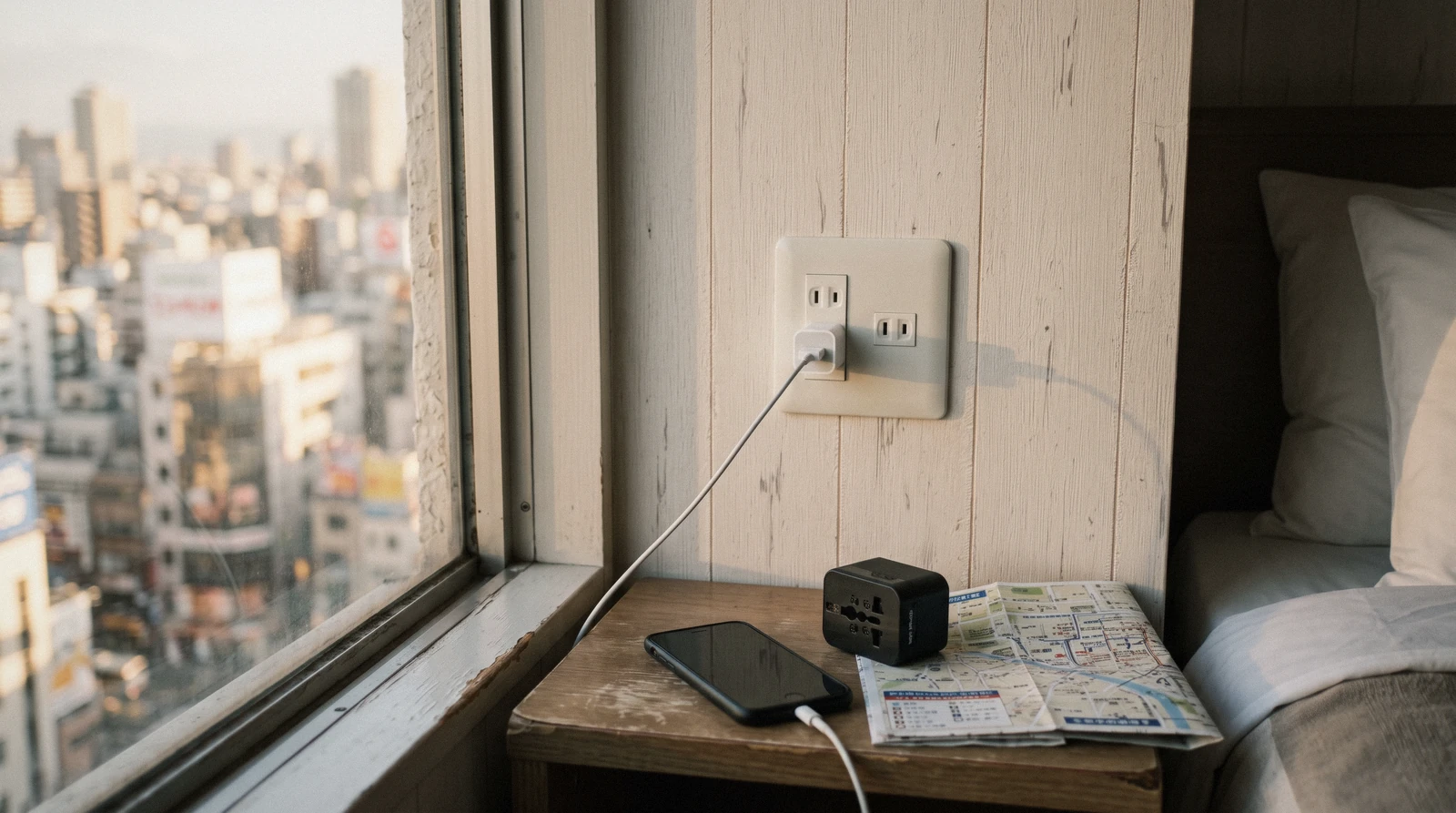
The Japan plug type is A or B, two flat pins with an optional round earth pin, on a 100 V supply that runs at 60 Hz in Osaka. Pick your home country below to see whether your plugs fit and whether you need a converter, then read which adapter to bring, how the 100 V supply treats your chargers and the other Osaka essentials to sort before you land.
Quick answer Plug types, voltage, Osaka's 60 Hz and who needs an adapter
Japan uses plug types A and B at 100 V, and Osaka sits in the 60 Hz west of the country. Type A is two flat parallel pins, so plugs from the UK, Ireland, Australia, continental Europe and South Korea need an adapter, and the checker below answers for your country.
Key takeaways
- Pick your home country in the plug and voltage checker before you pack.
- US travellers with a three-pin type B plug need a socket with an earth hole or a three-to-two adapter, because most room sockets take two flat pins only.
- Phone and laptop chargers labelled 100-240 V need only an adapter, never a converter. Single-voltage hair dryers need a transformer.
- Plugs sorted? Price your ride in from the airport with the Kansai Airport cost calculator.
Do You Need a Plug Adapter for Japan?
Pick your home country and the checker shows whether your plugs fit a Japanese outlet and whether the voltage matches your devices. The 22-country table gives the same answer at a glance.
| Your country | Your plugs | Adapter in Japan | Your voltage |
|---|---|---|---|
| United States | A, B | Not needed for type A, B | 120 V |
| Canada | A, B | Not needed for type A, B | 120 V |
| Mexico | A, B | Not needed for type A, B | 127 V |
| United Kingdom | G | Needed | 230 V |
| Ireland | G | Needed | 230 V |
| Germany | C, F | Needed | 230 V |
| France | C, E | Needed | 230 V |
| Spain | C, F | Needed | 230 V |
| Italy | C, F, L | Needed | 230 V |
| Netherlands | C, F | Needed | 230 V |
| Portugal | C, F | Needed | 230 V |
| Australia | I | Needed | 240 V |
| New Zealand | I | Needed | 230 V |
| Brazil | C, N | Needed | 127 V and 220 V (varies by region) |
| Argentina | C, I | Needed | 220 V |
| Chile | C, L | Needed | 220 V |
| South Korea | C, F | Needed | 220 V |
| China | A, C, I | Not needed for type A | 220 V |
| India | C, D, M | Needed | 230 V |
| Israel | C, H, M | Needed | 230 V |
| South Africa | C, M, N | Needed | 230 V |
| Thailand | A, C, some three-pin | Not needed for flat two-pin type A. Round-pin plugs need one | 220 V |
Source: Japan National Tourism Organization, IEC World Plugs, Tourism Authority of Thailand.
Plugs Sorted? Book the Ride From Kansai Airport
Your phone is charged, now the first hour in Osaka. The listings below take you from Kansai Airport to your hotel at a price set before you land: a private car per vehicle and a shared van per person.
 from $64.79
Kansai Airport (KIX): Private One-Way Transfer to/from Osaka
A private one-way car to or from Kansai Airport, with 60 minutes of free waiting on arrivals and flight delays covered up to two hours. The case for it is luggage and a late landing rather than speed: the train takes about as long.
Check Availability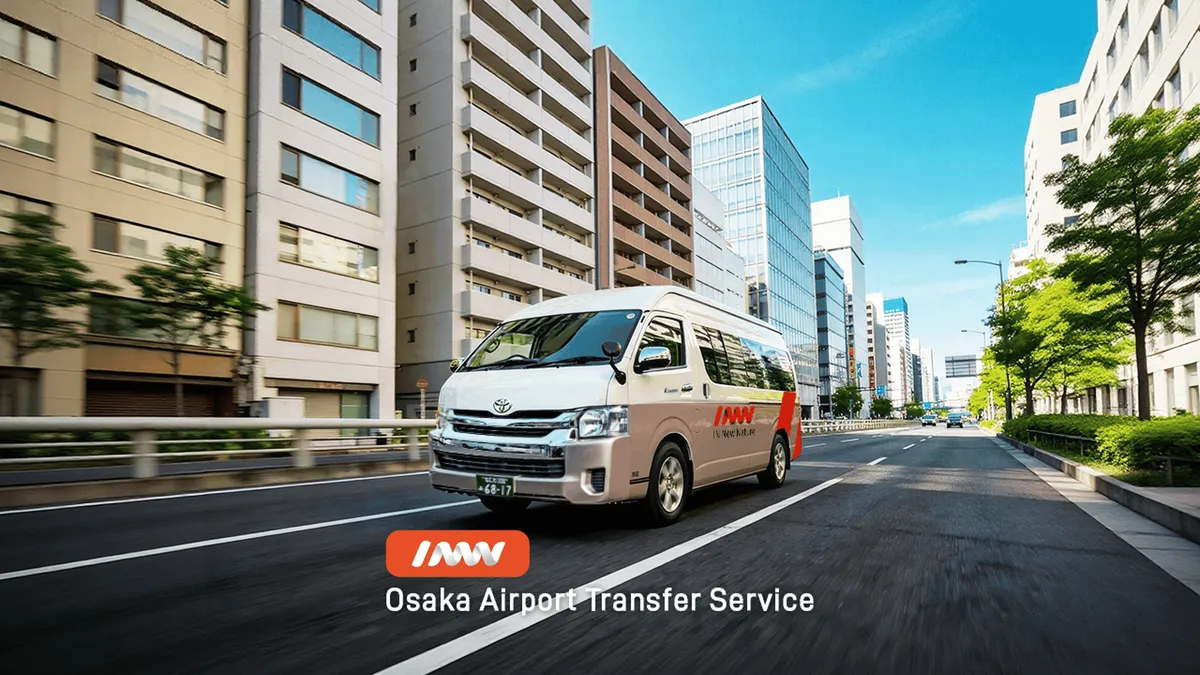 from $15.98
Osaka: Kansai Airport Shared Transfer Early Bird Reservation
A scheduled shared shuttle between Kansai Airport and 24 districts of the city, booked ahead and boarded with a QR code, tolls included. Cheaper than a taxi and closer to your door than the train, at the cost of a fixed departure time.
Check AvailabilityPrices, ratings and details are the platform's own. Dollar figures are the listed prices. The platform bills in your account's currency.
Which Plug Is Used in Japan?
Japan uses two plug types, A and B.
Types A and B
Type A has two flat parallel pins. Type B adds a round earth pin below them, so it has three pins in total. Those two letters are the whole list for Japan.
What This Means for Your Charger
Most sockets you meet in hotel rooms, cafés and apartments accept the two flat pins only. A two-pin type A plug slides straight in. A three-pin type B plug needs a socket with an earth hole or a small three-to-two adapter.
If your charger ends in two flat pins, you are covered everywhere in Japan.
Source: IEC World Plugs, JNTO.
Are Japan and US Outlets the Same?
Japan and the US share the same plug family, but the voltage differs.
Same Plugs, Different Power
Japanese and American outlets both accept the same flat-pin plugs, types A and B. The difference is behind the socket. Japan runs at 100 V across the whole country. The United States runs at 120 V. Most modern chargers tolerate both, which is why the label on the plug matters more than the country you are in.
Can I Use My USA Plugs in Japan?
Yes, physically they fit. A two-pin US plug goes into almost every Japanese socket. The catch is the earth pin.
If your plug has three pins, look for a Japanese socket with an earth hole or carry a small three-to-two adapter. And check the label first. A charger marked 100-240 V works as normal.
A single-voltage appliance may need a transformer, covered below.
Source: JNTO, IEC World Plugs.
Which Plug Adapter Do You Need for Japan?
You need an adapter unless your plug already has two flat parallel pins.
The table below compares your home plug with what fits a Japanese socket, using the plug types the IEC World Plugs list gives for each country. Find your country, then look at what to bring. The checker under this section covers every country in the full list.
| Your plug | Typical countries | What to bring |
|---|---|---|
| Type A or B | United States, Canada, Mexico | Nothing for type A. A three-pin type B plug needs a three-to-two adapter |
| Type G | United Kingdom, Ireland | Adapter ending in two flat pins |
| Type I | Australia, New Zealand | Adapter ending in two flat pins |
| Type C, E or F | Germany, Spain, Italy, Netherlands, South Korea, France, Portugal | Adapter ending in two flat pins |
| Type C or I (China also A) | Argentina, China | Adapter ending in two flat pins for type C or I. A Chinese type A plug fits as it is |
| Type A, C or Thai three-pin | Thailand | Nothing for a flat two-pin type A plug. A round-pin plug needs an adapter ending in two flat pins |
One adapter covers the whole trip. Any adapter that ends in two flat parallel pins fits every standard Japanese socket. Buy one before you leave or pick one up in Osaka, where adapters are sold in electronics quarters such as Nipponbashi and at Yodobashi Camera or Bic Camera stores.
Are Japanese Plugs the Same as European Ones?
No. Continental Europe uses round-pin plugs, types C, E and F, at 230 V, and the UK and Ireland use the three-pin type G. Japan uses flat-pin types A and B at 100 V. Neither European plug fits a Japanese socket, so every European traveller needs an adapter ending in two flat pins. The voltage matters too: a European appliance built for 230 V only runs weakly or not at all on Japan's 100 V, so check the label before packing it, as the converter section explains.
Source: JNTO, IEC World Plugs, Tourism Authority of Thailand.
Do You Need a Voltage Converter for Japan?
Most chargers need no converter. Single-voltage appliances might.
Adapter, Transformer and the Label on Your Charger
An adapter changes the shape of your plug. A transformer, sometimes called a step-down converter, changes the voltage. Japan runs at 100 V uniformly. An appliance built for 230 V only runs weakly or not at all on a 100 V supply. An appliance built for 100 to 240 V runs perfectly with just an adapter.
Turn your charger over. If the fine print says something like 100-240 V, 50/60 Hz, it is dual voltage and needs nothing but an adapter. Most phone, laptop and camera chargers carry this label.
Dual-voltage hair dryers, travel irons and shavers work anywhere in Japan, as the national tourism organisation notes. Other appliances, such as a hair dryer or a styling tool built for one voltage only, need a transformer that converts the voltage and is rated for their wattage. Check the label before you fly, or leave the single-voltage dryer at home.
Source: JNTO.
Osaka Runs on 60 Hz: What That Means and Where to Buy an Adapter
Osaka runs on 60 Hz, while eastern Japan runs on 50 Hz.
Two Frequencies, One Country
Japan is split. Western Japan, including Osaka, Kyoto and Nagoya, runs at 60 Hz. Eastern Japan runs at 50 Hz.
For phone and laptop chargers this is irrelevant, since dual-voltage chargers handle both frequencies. It matters only for appliances with motors or clocks built for a single frequency,, such as some older clocks and timers, which can run fast or slow on the other frequency. For a short trip with ordinary chargers, you can ignore frequency entirely.
Where to Buy an Adapter in Osaka
Forget your adapter at home and it is a small errand, not a crisis. Osaka's Nipponbashi electronics quarter sells plugs and transformers of every kind, and you can wander the area as part of a Namba day. The big chains Yodobashi Camera and Bic Camera stock them too, as the Japan National Tourism Organization notes.
Source: JNTO.
Other Osaka Essentials to Sort Before You Land
Tap water is safe to drink, 110 and 119 are the emergency numbers, and tax-free shopping is now a refund at departure.
The table below gathers the everyday essentials: whether the tap water is drinkable, which numbers to call in an emergency, and how tax-free shopping works now that the system changed on 1 November 2026. Each row notes the official body behind the information, so you can read the full detail there if you need it.
| Essential | What to know | Source |
|---|---|---|
| Tap water | Treated Yodo River water, described as safe and clean potable tap water, with ozone and granular activated carbon treatment | Osaka City Waterworks Bureau |
| Police | Call 110 for police emergencies | Osaka Prefectural Police |
| Fire and ambulance | Call 119 for fire and ambulance | Osaka City Fire Bureau |
| Should I call an ambulance? | Osaka Emergency Consultation Centre, #7119 or 06-6582-7119, open 24 hours, helps you decide | Osaka City Fire Bureau |
| Japan Visitor Hotline | 050-3816-2787, 24 hours, in English, Chinese and Korean | JNTO |
| Tax-free shopping | From purchases made on or after 1 November 2026 you pay the tax-inclusive price in store and the tax is refunded at departure after a customs check at a tax-free procedure terminal at the airport. Show your passport. Minimum $31.35 (¥5,000) excluding tax per day at the same store, and goods must leave Japan within 90 days of purchase | Japan Tourism Agency |
For the wider safety picture, read whether Osaka is safe, and for what a day in the city adds up to, see Osaka trip costs. Tax-free refunds are claimed at the airport on the way out, so allow time at a tax-free procedure terminal on your departure day.
Source: Osaka City Waterworks Bureau, Osaka Prefectural Police, Osaka City Fire Bureau, JNTO emergency guide, Japan Tourism Agency.
Japan Plug Type FAQ
Are Japan and US outlets the same?
They use the same plug family, types A and B with flat pins. The voltage differs. Japan runs at 100 V across the country while the US runs at 120 V. Most modern chargers handle both, so for phones and laptops the plugs are interchangeable.
Which plug adapter do I need for Japan?
Any adapter ending in two flat parallel pins fits Japanese sockets. Travellers from the UK, Ireland, Australia, New Zealand, continental Europe and South Korea need one. Travellers from the US, Canada and Mexico with two-pin plugs need nothing, and a three-pin plug needs a three-to-two adapter.
Can I use my USA plugs in Japan?
Yes. Two-pin US plugs fit Japanese sockets directly. A three-pin type B plug needs a socket with an earth hole or a small three-to-two adapter, because most Japanese sockets take two flat pins only.
Which plug is used in Japan?
Japan uses types A and B. Type A has two flat parallel pins. Type B adds a round earth pin below them, making three pins in total.
What is the voltage in Osaka?
100 V, the same uniform voltage used across all of Japan. Osaka is in western Japan, which runs at 60 Hz. Chargers labelled 100-240 V work as normal with just a plug adapter.
Do I need a converter for my hair dryer in Japan?
If your hair dryer is dual voltage, marked 100-240 V, no. A single-voltage 230 V or 120 V dryer needs a transformer rated for its wattage, or stays at home. Dual-voltage hair dryers, travel irons and shavers work anywhere in Japan, according to the Japan National Tourism Organization.
Is Osaka tap water safe to drink?
Yes. The Osaka City Waterworks Bureau treats Yodo River water with ozone and granular activated carbon into safe and clean potable tap water. It comes out of the tap ready to drink.
Is the Japanese plug type the same as Thailand?
Partly. Thai sockets take both flat two-pin plugs and round two-pin plugs, and Japan takes only the flat ones. A Thai plug with two flat pins fits a Japanese socket as it is, while a round-pin plug needs an adapter. Thailand runs at 220 V and Japan at 100 V, so a single-voltage Thai appliance needs a converter too. The checker above gives the answer for 22 countries.
Prices, hours and terms are set by the venue or operator and confirmed at checkout.
We may earn a commission if you book through one of our links, at no extra cost to you. Full affiliate disclosure