 Osaka City Guide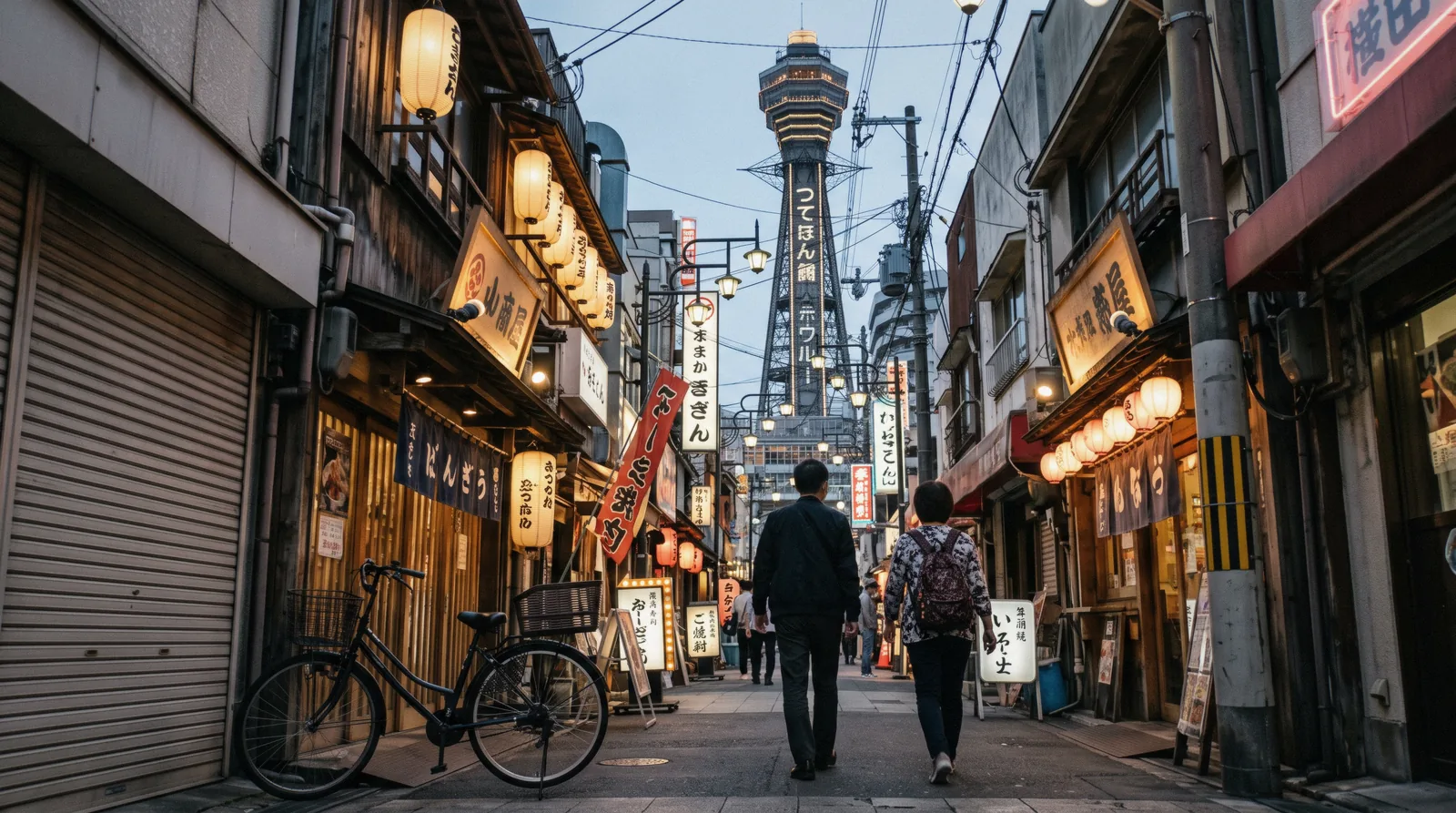
Shinsekai
Shinsekai — the name means new world — is a few square blocks of Naniwa-ku where the signage is louder than anywhere else in Osaka and the food is cheaper than anywhere in Minami. It is free, it has no gate and no closing hour, and the city's tourism bureau dates its origins to 1903, when the Fifth National Industrial Exposition was held at Tennoji and on the ground the district now covers. This page covers what the alley actually holds, the one kushikatsu rule the bureau prints in writing, what the paid attractions around it cost, and how the district's reputation stands up to the sources. Yen first throughout, with dollar approximations at ¥1,000 = about $6.27 (European Central Bank reference rate via frankfurter.dev). For the rest of the city, see top places to visit in Osaka.
Quick answer Free, never closes, one rule, 130 metres of alley
Shinsekai is free to walk and never closes — it is a district, not an attraction, so there is no gate, no ticket and no published opening time. Its origins go back to 1903 and the Fifth National Industrial Exposition held at Tennoji and on this ground; the landmarks the city names are the tower, Janjan Yokocho and the giant pufferfish lantern. From the Osaka Convention and Tourism Bureau's own spot page.
Key takeaways
- Janjan Yokocho is the reason to come: about 50 establishments packed into 130 metres of covered alley, frying kushikatsu and simmering doteyaki, with the Billiken and pufferfish photo spots at either end
- The rule the bureau prints in writing is the no double dipping rule — the communal sauce tin gets one pass per skewer, and the cabbage on the counter is the free scoop you use instead of a second dip
- The two evening walks that run here, the most-booked one at $60.86 and the higher-rated one at $69.79, both buy the same thing: somebody who knows which of forty near-identical counters is the one to sit at
- Everything else in these blocks is priced separately — the tower now sells timed slots only, the bathhouse charges by the day of the week, and the full walk-up comparison is in the table below
Key facts
Opening hours
| The streets themselves, all year | Open at all hours–No closing time |
|---|---|
| Shops and stalls | Vary by business–Most fryers work into the evening |
Closed None for the district; individual shops set their own closed days and none is published centrally
Admission
- Adult
- Free to walk — you pay only for what you eat
- Reduced
- Not applicable
- Free
- The whole district, at any hour
Planning it
- Time needed
- Not stated by any authority; our routing: 90 minutes to walk and eat, two and a half hours if you add the tower
- Book ahead
- Optional — walk-up usually fine
- Address
- Ebisu-higashi, Naniwa-ku, Osaka — adjacent to Ebisucho Station on the Osaka Metro Sakaisuji Line
Nothing in Shinsekai is ticketed, so what this table compares is whether somebody walks it with you and what that buys. District details are the tourism bureau's own, read on in Q3 2026; the tour prices are GetYourGuide's listings on the same date, in the platform's US dollars.
Nothing here is ticketed and skewers are paid shop by shop, so the question is whether a guided evening is worth $60.86 and up — and whether you want this district alone or paired with the canal strip.
| Option | Price | What it covers | Cancel | Book |
|---|---|---|---|---|
| Walk it yourselfAnyone with an evening; Janjan Yokocho has no gate and no closing time | Free; skewers paid shop by shop | The whole district at any hour, Janjan Yokocho included; no gate, no ticket, no closing time | Not applicable | Official site |
| Evening food tour, 15 dishes and 3 drinks, 3 hoursThe cheapest guided evening, and the only one with hotel pickup | From $60.86 | Five venues — a stall, a gastrobar, a classic eatery, an izakaya, a specialist restaurant — with hotel pickup | Free up to 24 hours before | Check Availability |
| Street-food tour, 15 tastings and 3 drinks, 3 hoursTravellers meeting at the station who want fifteen tastings across five venues | From $69.79 | An izakaya, a stall, a standing bar and two restaurants; meets at Exit 3 of Ebisucho Station | Free up to 24 hours before | Check Availability |
| Two-district food tour, 3 hoursPeople with a single night who want these streets and the canal in one go | From $104.87 | Pairs these streets with the canal strip in one evening, for people with only one night in the city | Free up to 24 hours before | Check Availability |
The reason these walks sell at all is that the alley is not self-explanatory. Forty counters fry the same skewers behind the same plastic curtains, almost none of them post an English menu, and the ordering convention — you take what the fryer hands you, in ones and twos, and settle at the end — is nowhere written down. Walking it alone is entirely possible and costs nothing; you will simply eat at whichever counter has a free stool.
Guided walks that actually come here
Five cards, and only the first two are routed through these streets end to end — the rest pass through as one stop among several. Prices are the platform's own listings in US dollars; the operator bills in your account's currency at checkout.
 from $60.86
Most booked
from $60.86
Most booked
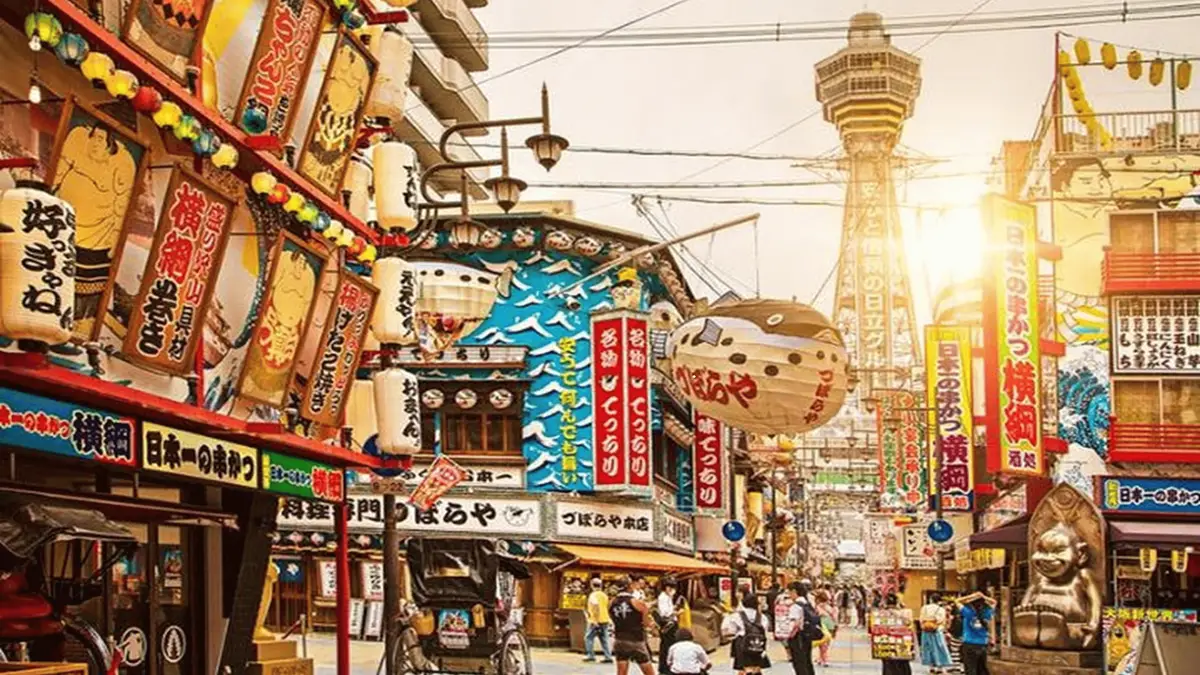
Osaka: Food Tour with 15 Dishes & 3 Drinks with a Local Expert
The same shape as the Hungry Osaka walk — five Shinsekai venues, fifteen dishes, three drinks — for about nine dollars less, with far more reviews behind the rating and hotel pickup included.
Check Availability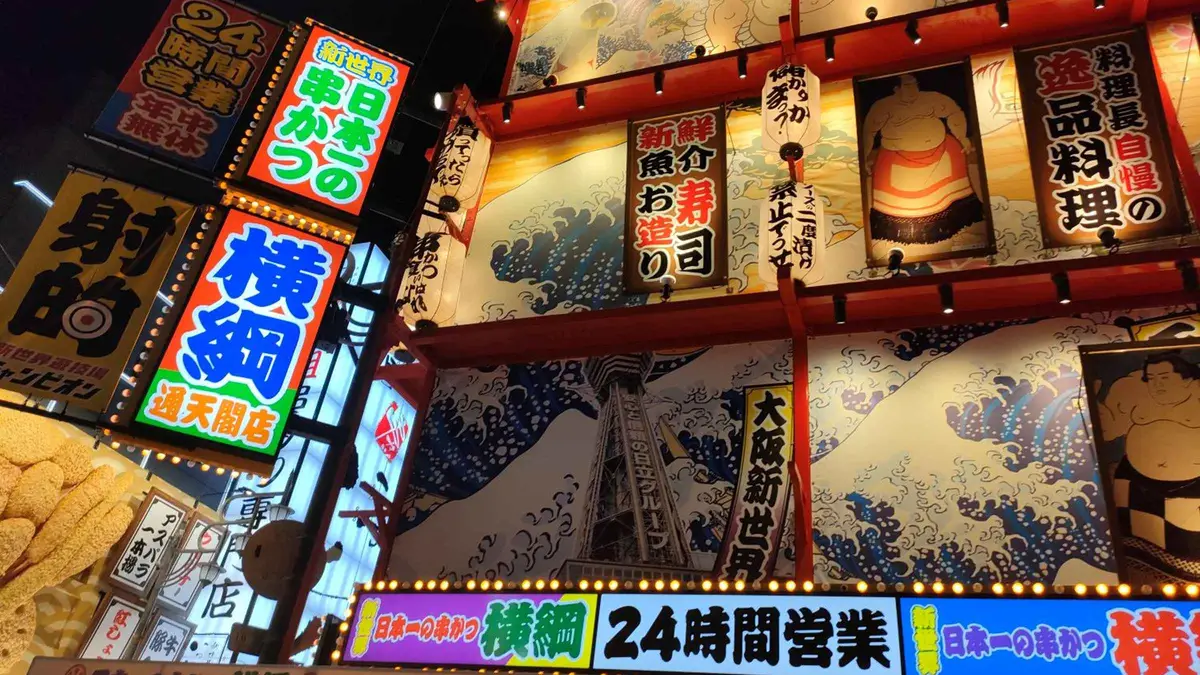 from $69.79
Hungry Osaka Street Food Tour Shinsekai: 15 Tastings 3 Drinks
Fifteen tastings and three drinks across an izakaya, a stall, a standing bar and two restaurants in Shinsekai, over three hours. The best rated of the big evening food walks; getting there and home afterwards is your own affair.
Check Availability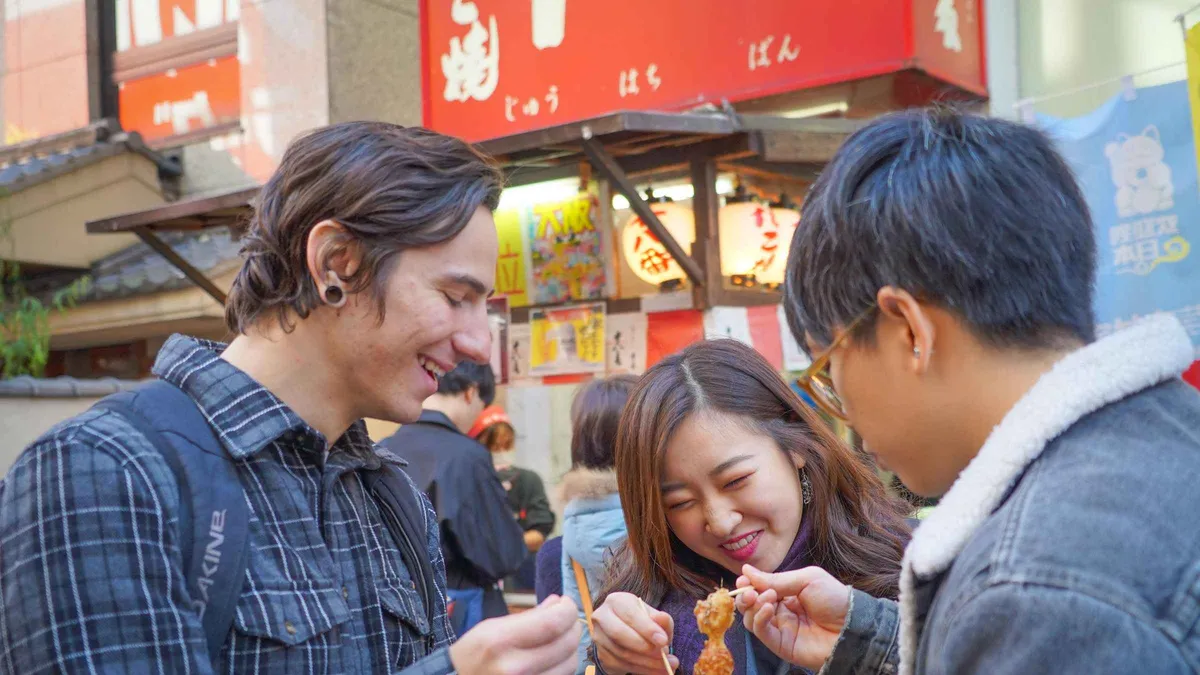 from $104.87
Osaka: Local Foodie Tour in Dotonbori and Shinsekai
Three hours across Shinsekai and Dotonbori taking in kushikatsu, takoyaki and an okonomiyaki you cook yourself, with two drinks. The dearest food walk here, and the ¥190 train fare between the two districts is on you.
Check Availability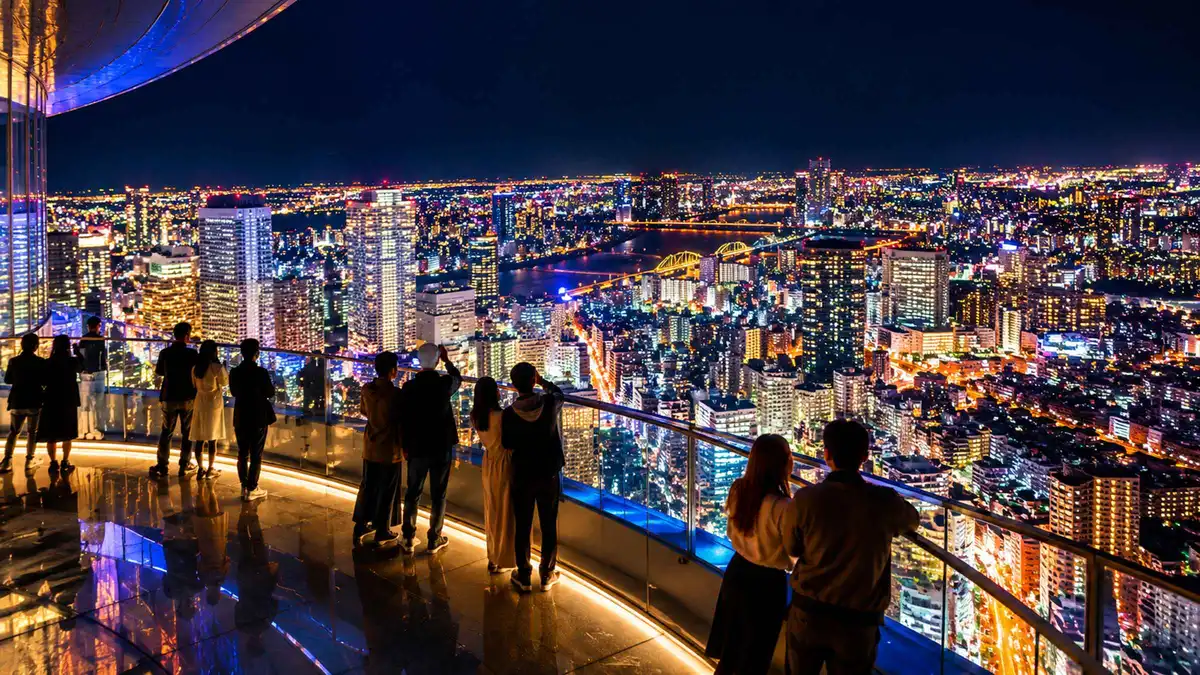 from $69.92
Osaka Night: Umeda Sky Building + Shinsekai Neon
Timed for sunset on the open roof at Umeda, then down into the Shinsekai neon, with the observatory ticket included and the guide taking your photographs. A new listing, so there are no ratings behind it yet.
Check Availability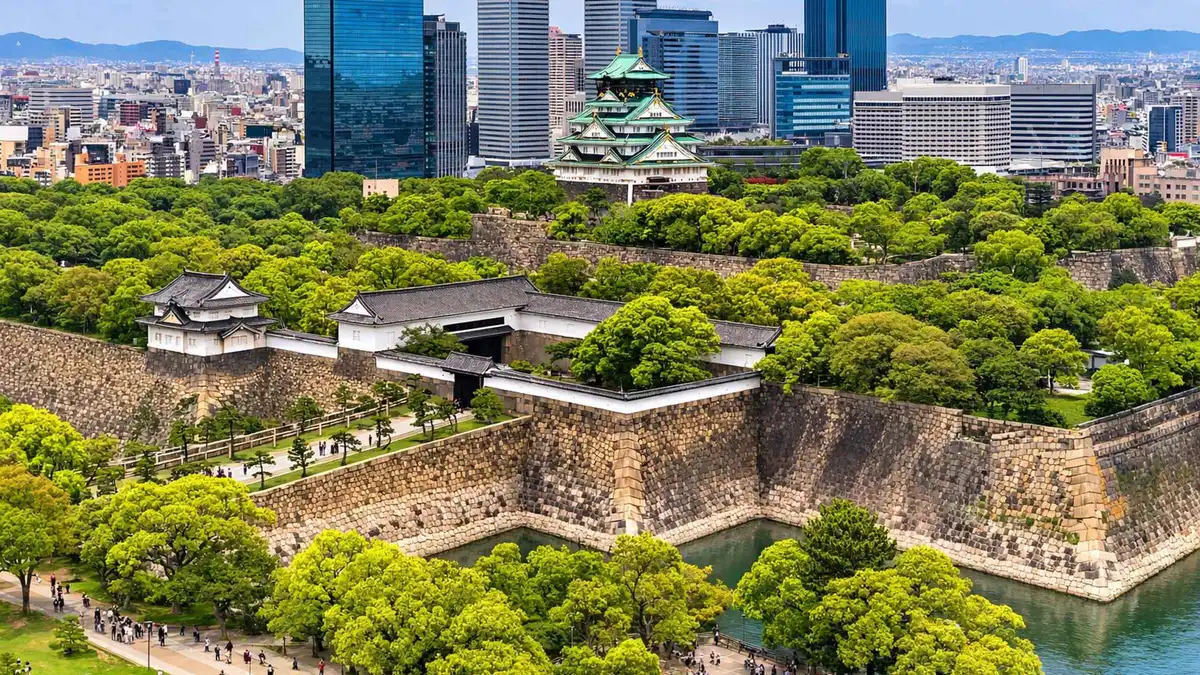 from $54.56
Osaka: Guided Walking Tour with a Native Expert – Top Sights
Four hours linking Osaka Castle, Tsutenkaku and Namba by metro, with the ¥1,200 keep admission included and the ¥430 of train fares not. A Japan Rail Pass buys you nothing here — the route runs on Osaka Metro.
Check AvailabilityPrices, ratings and details are the platform's own. Dollar figures are the listed prices. The platform bills in your account's currency.
What the district is, and what it is not
The name means new world, and the bureau's own account of where it came from is shorter and more specific than most of what circulates.
The Osaka Convention and Tourism Bureau puts the origins in 1903, when the Fifth National Industrial Exposition was held at Tennoji and across the ground the district now occupies. That is the whole of the official origin story in English: an exposition site that became a leisure quarter. The three landmarks the bureau names are the tower at the centre, Janjan Yokocho, and the giant pufferfish lantern that hangs over the main street — and the pufferfish is a genuine local marker rather than a decoration, because fugu restaurants have concentrated here for decades.
What the bureau does not print is the part every guidebook leads with: the 1912 opening, the Luna Park amusement grounds, the New York-and-Paris story about how the two halves of the district were laid out. We could not find that on any official page, so this guide does not state it as fact. Where you see it repeated with confidence, it is coming from Wikipedia and from each other.
The reputation question, answered with what is actually published
Search results for this district fill up with the word dangerous, and the honest answer is that no authority publishes a district-level safety ranking for Osaka that we could cite. What does exist, and what is worth carrying, is much duller: Osaka Prefectural Police run 110 for a crime or a traffic accident and #9110 for non-emergency consultation, and the one street rule the city actually enforces here is the smoking ban.
Osaka City extended its street-smoking ban to the entire city on Monday 27 January 2025 — roads, squares, parks and other public places the city manages — and heated tobacco is covered as well as lit cigarettes. The penalty is a $6.27 (¥1,000) non-criminal fine. In a district this dense with standing bars, that is the rule most likely to catch a visitor out.
Janjan Yokocho: 130 metres, about 50 places
The alley is the thing you actually came for, and it is smaller than the photographs suggest.
The bureau's figures: approximately 50 establishments, stretching 130 metres. That works out at one business every two and a half metres, which is why the alley reads as a single continuous kitchen rather than a street of shops. The trades are kushikatsu and doteyaki — beef sinew simmered for hours in miso and mirin — plus standing bars, a couple of shogi and go parlours that have been there for generations, and the Billiken and pufferfish photo spots at the ends.
The alley is covered, which matters more than it sounds. Osaka's wet months run June to September, and the ERA5 reanalysis for 1995 to 2024 puts June at 193 mm of rain over 13.4 rainy days, July at 197 mm over 15.0 and September at 169 mm over 12.3. Janjan Yokocho is one of the few evening plans in the city that a downpour does not alter at all.
The practical trap is width. Two people abreast plus a queue outside a popular fryer effectively closes the alley, so nothing here works with a suitcase — the luggage lockers exist for exactly this, and the getting-around page has the station ones.
Kushikatsu, and the one rule that is actually written down
The sauce tin on the counter is communal, which is the whole reason the rule exists.
The tourism bureau describes kushikatsu as a representative Osaka B-class dish known for its no double dipping rule, and places it in this district, around the tower. That is the phrasing on the city's own konamon page, and it is worth quoting because it settles an argument tourists have constantly: the rule is not folklore invented for visitors, it is how the city itself explains the dish.
The mechanics: skewered pieces of meat, vegetable, cheese or seafood are crumbed, fried and handed to you one or two at a time. A shared stainless tin of thin worcester-style sauce sits on the counter. You dip the skewer once, before you bite it. After that the skewer is out of the sauce for good — and the pile of raw cabbage leaves next to the tin is not a garnish, it is the scoop: fold a leaf, use it to ladle more sauce onto whatever you are eating, eat the leaf.
Ordering runs the same way in almost every shop. You do not order a set; you order in ones and twos as you go, the fryer tracks what you have had by the sticks in the cup in front of you, and you settle at the end. Most counters are eight to twelve seats. Solo diners are the norm rather than the exception.
- One dip per skewer, before the first bite — the tin is shared with everyone at the counter
- The cabbage is the sauce ladle and the palate cleanser, and it is free and refilled
- Order two or three at a time, not a list; the point is to stop when you want
- Beer, highball, or the free tea — the sinus-clearing horseradish skewer is the local dare
- Cash still moves faster than a card at the older counters
What the Michelin selection says about this, which is nothing
It is worth being straight about the quality ceiling. The MICHELIN Guide Kyoto Osaka 2026 recognises kushiage as an Osaka genre and gives it Bib Gourmand addresses — Kushikatsu Gojoya at 2-1-11 Uchihiranomachi in Chuo-ku, and kushiage 010 in Sonezakishinchi in Kita-ku — and neither of them is here. The Osaka selection contains no takoyaki venue and no okonomiyaki venue at all either, which is why this guide names no shop for those two dishes anywhere.
So the honest positioning is this: these streets are where the dish is cheapest, most concentrated and most fun, and the guide-listed versions of it are a subway ride north. Both facts are true at once. Michelin publishes no opening hours and no closed day for any of its Bib Gourmand addresses, so if you go looking for either, check the venue's own site first. The food page sets out the rest of the city's eating in the same terms.
What the paid attractions in these blocks cost at the door
The district is free; everything inside it is not. Adult walk-up prices from each venue's own site, with dollar approximations at ¥1,000 = about $6.27.
| Place | Walk from the alley | Adult at the door | Closed | Book ahead |
|---|---|---|---|---|
| The streets and Janjan Yokocho | 0 min | Free | Never | No |
| The tower at the centre | About 3 min | $9.41 (¥1,500), child ¥800 | Not published — the tower announces closures on its own X account only | Yes — a timed slot is now required for every ticket |
| The bathhouse, with the pool | About 5 min | $12.54 weekdays / $16.93 weekends and holidays (¥2,000 / ¥2,700) | None published | No |
| Tennoji Zoo | About 6 min to the Shinsekai gate | $5.02 (¥800) | Every Monday, and 29 December to 1 January | No |
| Bathhouse without the pool | About 5 min | $9.41 all days (¥1,500) | Onsen floors close 08:45–10:00 for cleaning | No |
Two discounts worth knowing before you pay twice. The zoo sells adult entry at ¥720 and child at ¥180 on production of a same-day or online tower ticket, valid to the end of the month after your visit. And the Osaka Amazing Pass at ¥3,500 covers the tower's observation deck and the zoo among its 41 free entries — it does not cover the bathhouse, and it is not valid to or from Kansai Airport. Entering or staying at the bathhouse between 00:00 and 05:00 adds ¥1,300 plus a ¥150 bathing tax.
When to come, and what the district is doing at each hour
There is no opening bell, so the useful question is what is switched on.
Before about 11:00 the district is half-shuttered and quiet; the photographs everyone comes for do not exist yet, because the signage is what makes them and none of it is lit. From late morning the alley starts trading and the first fryers are going, and lunchtime is a genuinely good slot if you want a stool without waiting.
From about 17:00 everything is on. That is the hour the district is famous for: every sign lit, every counter working, the pufferfish glowing over the street. It holds until late — the tower's own last admission is 21:15, and the alley outruns it. The two food walks in the cards above are built around this window for the obvious reason.
One piece of programming worth timing around, from the bureau: the tower runs enka singers on Mondays and manzai comedy at weekends. Neither needs a booking of its own, and both explain why the crowd on a Monday afternoon here skews so much older than anywhere else in the city.
| Hour | What is happening | Worth it for |
|---|---|---|
| Before 11:00 | Half-shuttered, no signage lit, quiet streets | Photographs of the architecture rather than the neon |
| 11:00–15:00 | Alley trading, seats free, lunch prices | Eating kushikatsu without queueing for a stool |
| 15:00–17:00 | Filling steadily; the zoo's last admission is 16:00 | Pairing the zoo or the tower with an early dinner |
| 17:00–21:00 | Everything lit and every fryer working | The district as it is photographed — and the food walks |
| After 21:00 | Tower last admission 21:15; the standing bars keep going | A late drink with almost no visitors left |
Getting there: which station, which exit
Three stations sit within a few minutes, and they put you in different parts of the district.
The bureau names Ebisucho Station on the Osaka Metro Sakaisuji Line as the district's own station — it is adjacent, and Exit 3 comes up at the north end of the main street. That is also where the street-food walk in the cards above assembles, at the top of the Exit 3 stairs, fifteen minutes before the start.
Come from Namba or Umeda and the Midosuji Line drops you at Dobutsuen-mae instead, which reaches the alley's south end and the zoo gate. From the Tennoji side you walk in past the zoo. All three approaches converge on the same 130 metres.
Osaka Metro charges by zone rather than by distance, so anything from central Osaka lands in the first or second band. If the day already includes three or more rides, the Enjoy Eco Card pays for itself — and note that its weekend price follows the calendar and not the timetable, so Obon and New Year run holiday timetables but still sell the weekday card. The getting-around page has the rest.
| Zone or pass | Distance covered | Adult fare | Approximate USD |
|---|---|---|---|
| Zone 1 | Up to 3 km | ¥190 | $1.19 |
| Zone 2 | Over 3 km to 7 km | ¥240 | $1.50 |
| Zone 3 | Over 7 km to 13 km | ¥290 | $1.82 |
| Zone 4 | Over 13 km to 19 km | ¥340 | $2.13 |
| Zone 5 | Over 19 km | ¥390 | $2.45 |
| Enjoy Eco Card, weekday | All Metro and city bus lines, one calendar day | ¥820 | $5.14 |
| Enjoy Eco Card, weekend or holiday | All Metro and city bus lines, one calendar day | ¥620 | $3.89 |
Which station puts you where
- Ebisucho (Sakaisuji Line), Exit 3 — the north end of the main street and the tour meeting point
- Dobutsuen-mae (Midosuji and Sakaisuji lines) — the south end and the zoo gate
- Shin-Imamiya (JR Osaka Loop Line) — useful if you are already on the loop
Shinsekai map: the alley, the stations and what is next door
The district centre, the 130-metre alley and the three paid attractions within a six-minute walk. District coordinates from Wikidata, the alley from OpenStreetMap, the venues from their own access pages.
Pins are placed from published coordinates, not from our own survey: the district point is Wikidata's, the alley is OpenStreetMap's, and the tower and bathhouse are the figures on their own access pages.
Next stop from the alley
Everything here is a walk. Minutes are our estimates from the mapped distances, not official figures.
The tower at the centre
¥1,500 adult, ¥800 child, open to a 21:15 last admission — and since the change to timed entry, a slot has to be booked for every ticket, including for holders of a city pass, who book at the counter on the day. The tower page has the deck-by-deck detail and the slide.
3 minutesThe bathhouse
The obvious pairing with an evening of fried food: ¥2,000 on a weekday and ¥2,700 at weekends with the pool, ¥1,500 any day without it, and the onsen floors run from 10:00 through to 08:45 the next morning. Arriving or staying between midnight and 05:00 adds ¥1,300 plus a ¥150 bathing tax.
5 minutesTennoji Zoo
¥800, open 09:30 to 17:00 with a 16:00 last admission, closed every Monday. The summer 18:00 closing on May and September weekends ended from September 2026, so all days now finish at 17:00 — and a same-day tower ticket brings the adult price down to ¥720.
6 minutes to the Shinsekai gateThe canal strip and its signs
The comparison everyone makes. Two stops north on the Sakaisuji Line and a short walk, or one stop on the Midosuji Line from Dobutsuen-mae — the two-district food tour does both in one evening if you only have the one.
About 12 minutes by Metro from EbisuchoShinsekai questions
Is Shinsekai worth visiting?
Yes, for one evening and for a specific thing: it is the cheapest, densest concentration of fried skewers in Osaka, in a district that costs nothing to enter and never closes. Come at about 17:00 when everything is lit and the fryers are working. If you want a curated version of it, the most-booked evening walk is $60.86 for fifteen dishes and three drinks across five venues.
What does Shinsekai mean, and how old is the district?
The name means new world. The Osaka Convention and Tourism Bureau dates its origins to 1903, when the Fifth National Industrial Exposition was held at Tennoji and on the ground the district now covers. The 1912 opening and the Luna Park story that most guides lead with is not on any official page we could find, so this guide does not state it.
How big is Janjan Yokocho and what is in it?
About 50 establishments over 130 metres, per the tourism bureau — one business every two and a half metres. The trades are kushikatsu and doteyaki, plus standing bars and a couple of long-standing shogi parlours, with the Billiken and pufferfish photo spots at the ends. It is covered, so rain changes nothing about the plan.
What is the no double dipping rule on the kushikatsu street?
The tin of thin sauce on the counter is shared by everyone sitting at it, so each skewer goes in once, before the first bite. The raw cabbage beside the tin is the workaround: fold a leaf, use it to ladle sauce onto what you are eating, then eat the leaf. The city's own tourism pages describe the dish by this rule, so it is not an invention for visitors.
Is Shinsekai safe at night?
No authority publishes a district-level safety ranking for Osaka that we could cite, so anyone who gives you one is guessing. What is published: Osaka Prefectural Police run 110 for emergencies and #9110 for non-emergency consultation, and the city has fined street smoking $6.27 (¥1,000) everywhere in Osaka since 27 January 2025, heated tobacco included. The safety page carries the rest.
What are Shinsekai's opening hours?
It has none — it is a district of public streets with no gate. Individual shops set their own hours and closed days, and nobody publishes them centrally. In practice the alley is half-shuttered before about 11:00 and fully lit from about 17:00; the tower at the centre stops admitting at 21:15.
How long should I allow for Shinsekai?
Ninety minutes to walk it and eat, two and a half hours if you add the tower — our own routing, since no authority publishes a time. The distances are tiny: the whole alley is 130 metres and the paid attractions are all within six minutes on foot, so the time goes on queueing for a counter stool rather than on walking.
Where this fits in an Osaka day
It is an evening, and it pairs with exactly one other thing.
The efficient shape of the day is south in the afternoon and north at night, or the reverse. Zoo or tower at about 15:00, the alley from 17:00, the bathhouse afterwards if you want the local ending — that is a complete evening inside a six-minute radius, and the admissions for it are all in the table above.
The alternative is to treat it as the second half of a food night that starts on the canal, which is what the two-district tour sells. It is the more expensive route and it is the right one if you have a single night in the city. The one-day itinerary uses these streets as the evening; the two-day version has room to give them a whole one.
Shinsekai on film: the alley, the signage and the counters
Three walk-throughs, each id checked against YouTube's own record and its thumbnail so none of them is a dead player. Between them they cover the district by day, as a guided explainer, and after dark.
THE Shinsekai Osaka Guide: Better than Dotonbori?!
The comparison this district always draws, argued on camera in the streets themselves.
Video: PiQtour JapanShinsekai Walking Tour, Osaka Japan - Summer 2025 - [4K] With Captions
An uncut daytime walk, which is the honest version of what the alley looks like before the signs come on.
Video: Sit and Wander ToursOsaka Night Walk – Shinsekai After Dark | Japan | 4K HDR
The same streets after 17:00, when every sign is lit and every fryer is working.
Video: THE JAPAN WALKVideos load from YouTube only when you press play.
Prices, hours and terms are set by the venue or operator and confirmed at checkout.
We may earn a commission if you book through one of our links, at no extra cost to you. Full affiliate disclosure