 Osaka City Guide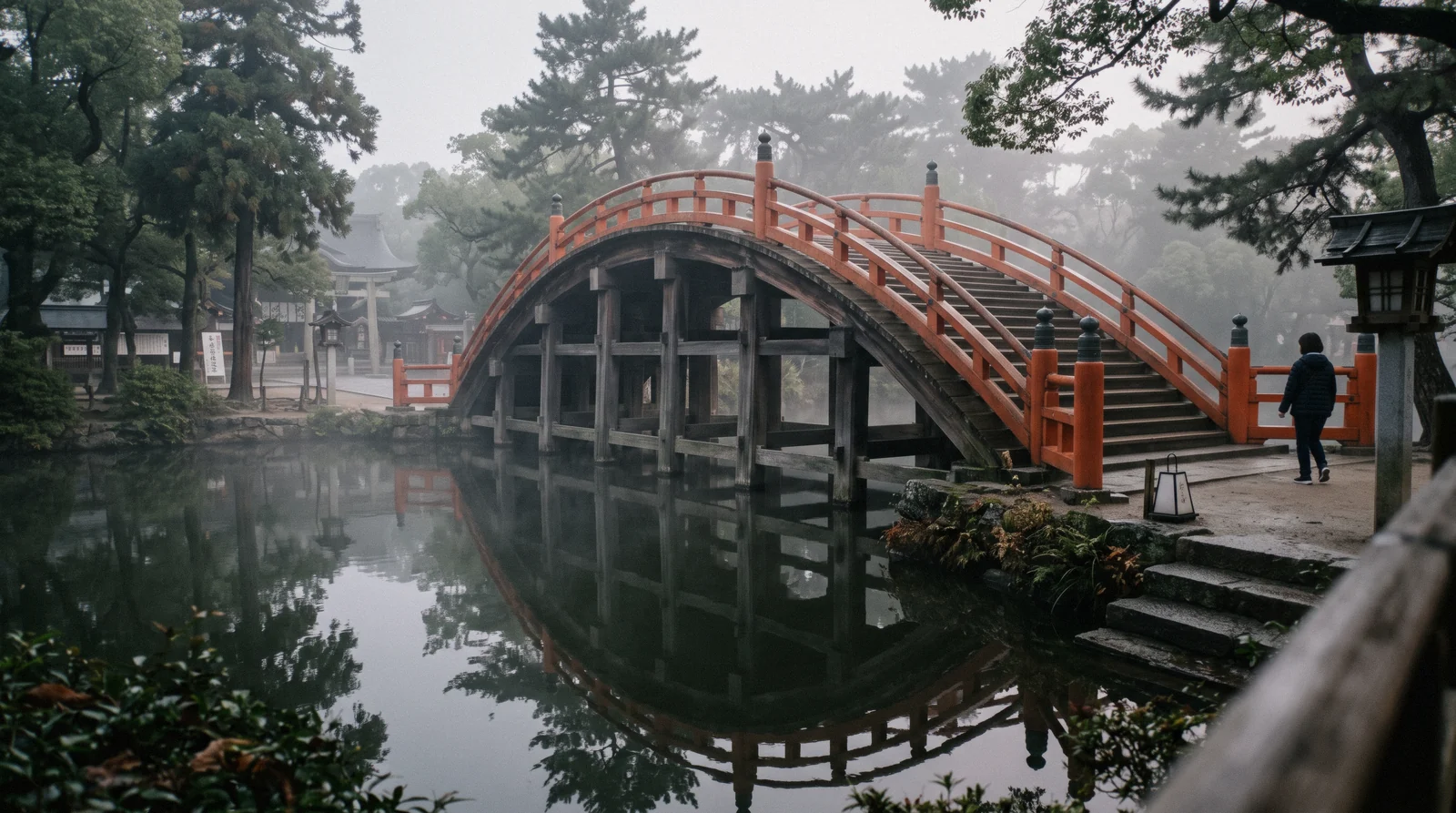
Sumiyoshi Taisha
Sumiyoshi Taisha is the head shrine of some two thousand Sumiyoshi shrines, the one whose four sanctuaries gave a style of architecture its name, and the reason a steeply arched red bridge is on half the postcards sold in southern Osaka. It is also the clearest case on this site of a place whose most-searched fact is not published. The shrine's own Japanese pages give gate times to the minute, prayer donations to the yen and a car-park tariff by the half-hour — and nowhere state an admission fee. This page prints what the shrine itself publishes, flags where its English and Japanese pages disagree, and says plainly which figures came from somewhere else. The city's other sights are covered in our guide to top places to visit in Osaka.
Quick answer No fee published, five different closing times, arrive before 16:00
Sumiyoshi Taisha publishes no admission fee. Not on its access page, not on its precinct pages, not in its price lists — the shrine states opening and closing times, prayer donations and a car-park tariff, and never an entry charge, so this page says "no fee published" rather than "free". The gates open at 06:00 from April to September and 06:30 from October to March, the outer gates close at 16:00, and the Migakiuchi inner precinct closes at 17:00 all year. Read on the shrine's own access page; yen figures below convert at ¥1,000 to about $6.27, the European Central Bank reference rate the same day.
Key takeaways
- 16:00 is the time that matters — the outer gates shut then, an hour before the inner precinct, and the shrine's English FAQ prints a single 17:00 closing that will strand you at a locked gate (the two versions compared)
- The only things the shrine puts a price on are prayers, amulets and the car park, and it takes cash only — the list of what is actually priced
- The Sorihashi drum bridge is the photograph, and it is steeper than it looks: over 40 degrees at its steepest, with steps added only in 1955
- No operator sells a tour of this shrine, so the guided route here is a private city walk you plan yourself — the three-to-seven-hour option is the only one that can reach this far south
Key facts
Opening hours
| Gates open, April to September | 06:00–16:00 |
|---|---|
| Gates open, October to March | 06:30–16:00 |
| Migakiuchi inner precinct, all year | 06:00–17:00 |
| Amulet office | 09:00–17:00 |
| Prayer reception | 09:00–15:50 |
Closed None published. The New Year period and the Sumiyoshi Matsuri run different opening and closing times and the shrine asks you to phone rather than assume
Admission
- Adult
- No admission fee published
- Reduced
- No admission fee published
- Free
- No entry charge is taken at any gate; the shrine states prices only for prayers, amulets and parking
Planning it
- Time needed
- Not stated by the shrine; our routing: 45 minutes for the bridge, the four main halls and the stone stage, 90 minutes with the four Hattatsu sub-shrines
- Address
- 2-9-89 Sumiyoshi, Sumiyoshi-ku, Osaka 558-0045 (shrine office 06-6672-0753)
There is no ticket for this shrine, which is exactly why the table exists: a page that quietly omits the question is how visitors end up hunting for a counter that does not exist.
No gate here takes an entry fee, so the only money questions are how you arrive and whether you pray. Parking is $1.25 (¥200) per 30 minutes and a sub-shrine prayer runs $6.27 to $9.41 (¥1,000 to ¥1,500).
| Option | What it costs | What it gets you | Book | Book |
|---|---|---|---|---|
| Walk in — the shrine itselfEveryone — four National Treasure halls at no charge, within gate times | No admission fee published | The four National Treasure halls, the bridge, the stone stage and the sub-shrines, within the gate times | Nothing to book | Official site |
| Car parkDrivers only; entry and exit run 06:00 to 20:00 and the rate can move in peak season | $1.25 (¥200) per 30 minutes, $12.54 (¥2,000) an hour for large vehicles | Entry and exit 06:00–20:00; the shrine warns the rate can move in peak season | No reservation for cars; coaches book ahead | Official site |
| A formal prayer at a sub-shrineVisitors doing the Hattatsu Mairi circuit of four sub-shrines; cash at the desk | $6.27 (¥1,000) to $9.41 (¥1,500) depending on the sub-shrine | The Hattatsu Mairi circuit of four sub-shrines, each with its own donation | At the desk, cash only | Official site |
| Private city walking tour, 3 to 7 hoursThe only guided product that can be pointed this far south — ask for it | From $35.71 | A guide and a route you agree beforehand — the only guided product that can be pointed this far south | Free up to 24 hours before | Check Availability |
| Small-group city loop, 5 hoursA general city loop; this shrine is not on its route | From $49.74 | The castle, the Showa backstreets and the neon strip; this shrine is not on the route | Free up to 24 hours before | Check Availability |
Times, donations and the parking tariff were read on sumiyoshitaisha.net in Q3 2026; tour prices are the platform's own USD listings, read the same day. If you take one thing from this table, take the cash. The shrine states on its own English FAQ that credit cards are not accepted — not at the amulet counter, not at Nankunsha — so the ¥1,500 prayer and the ¥800 sacred rice seed both need coins and notes you brought with you. There is no cash machine inside the grounds.
Guided walks that could include Sumiyoshi Taisha
An honest framing first. Not one of the 44 GetYourGuide products in this site's Osaka inventory names Sumiyoshi Taisha in its itinerary — we checked them all. The shrine sits in the far south of the city, off every standard sightseeing loop, and the operators route around it. The cards below are the city's three general guided walks: the first is private and its route is agreed with the guide, which makes it the only one that could take you here at all; the other two are fixed city routes shown for comparison so you can see what the guided market in Osaka actually sells. Prices are the platform's listings in USD.
 from $35.71
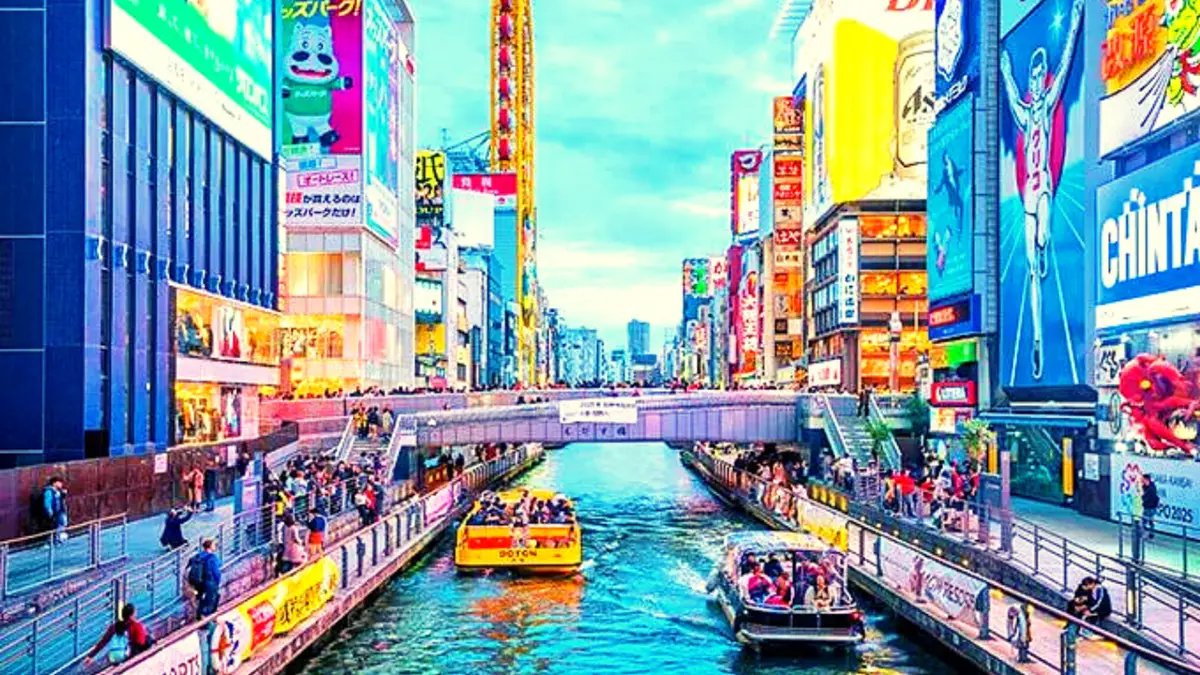
Osaka: Private or Group Hotspots & Hidden Gems Walking Tour
A three-hour walk that stretches to seven if you want it to, private or shared, with a takoyaki and a retro vending-machine drink included. The longer options use trains, which you pay for — usually under ¥1,000 a head.
Check Availability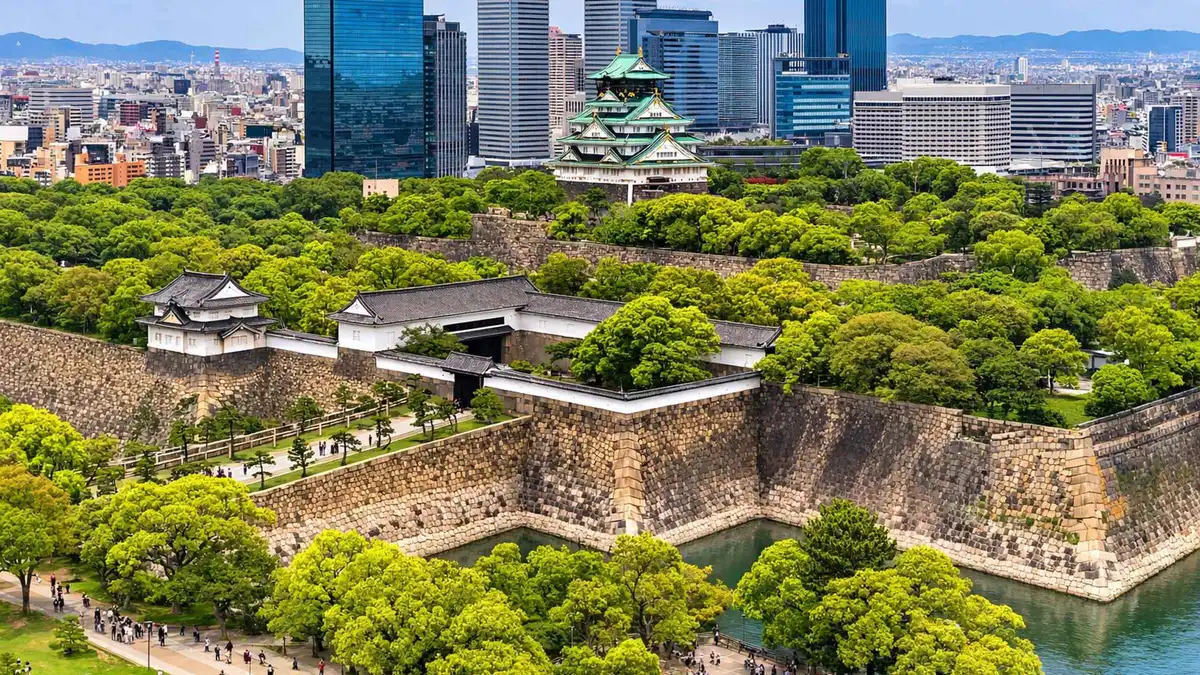 from $54.56
Osaka: Guided Walking Tour with a Native Expert – Top Sights
Four hours linking Osaka Castle, Tsutenkaku and Namba by metro, with the ¥1,200 keep admission included and the ¥430 of train fares not. A Japan Rail Pass buys you nothing here — the route runs on Osaka Metro.
Check Availability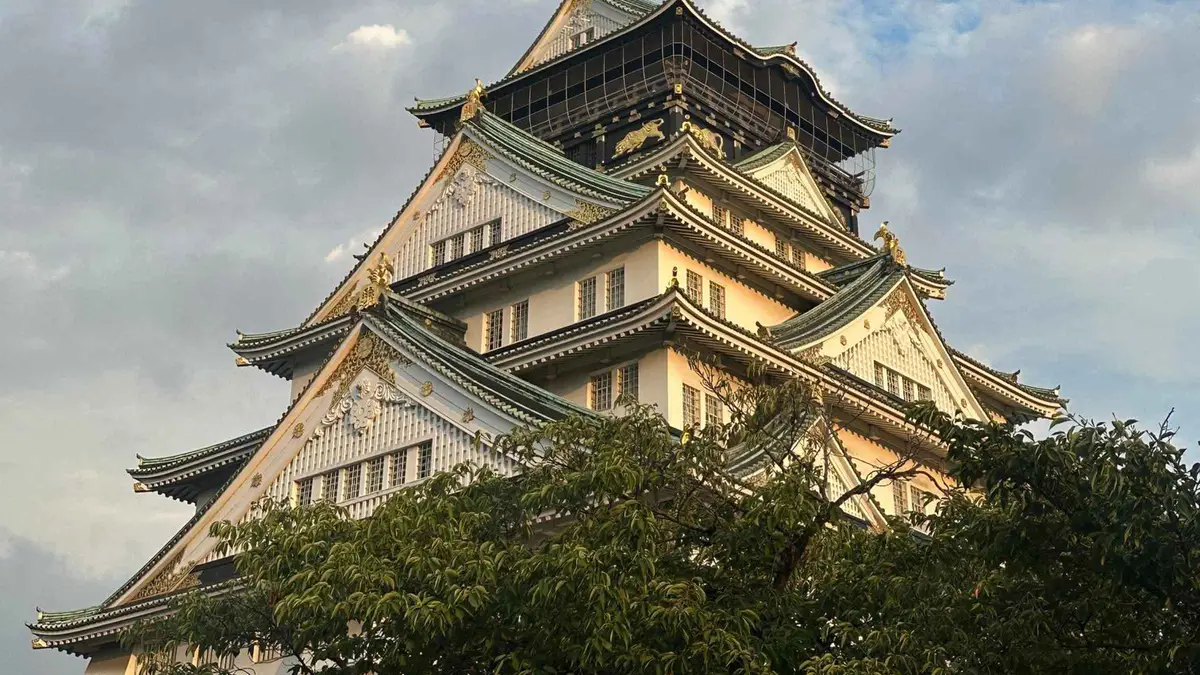 from $49.74
Osaka: Essential City Loop Tour with Local Guide
Five hours in a group of eight covering the castle, the Showa-era backstreets and the neon strip in one loop, with food bought stop by stop instead of a sit-down lunch. Only four people have rated it so far.
Check AvailabilityPrices, ratings and details are the platform's own. Dollar figures are the listed prices. The platform bills in your account's currency.
A shrine that was built for the sea, in a district with no sea left
Everything odd about this place — the layout, the bridge, the maritime deities in a landlocked suburb — comes from the coastline having moved.
Sumiyoshi Taisha enshrines three sea gods, the Sumiyoshi Sanjin, and the empress-regent Jingu, who according to the traditional histories founded it in the year 211. The shrine's own account says it stood on the shore of Osaka Bay; silt and land reclamation pushed the water west over the centuries until the grounds ended up in the middle of a residential district, about four kilometres inland. Between the seventh and ninth centuries the harbour beside it was the departure point for diplomatic missions to the Asian mainland, and the head-priest family boarded those ships. Sailors, fishermen and shipping companies still come here to pray for safe voyages.
Osaka calls it Sumiyossan, the way it shortens everything it is fond of. Two million people arrive over the first days of January for hatsumode, which is a scale worth knowing before you plan a New Year visit: the shrine's own notice sets traffic restrictions from 23:00 on 31 December through the evening of 1 January and again on the 2nd and 3rd, and closes the car park entirely from 31 December to 3 January.
Why the buildings look different from every other shrine
The four main halls are built in a style called sumiyoshi-zukuri, and this is the shrine it is named after. The features to look for: straight-edged gable roofs shingled in cypress bark, vermilion beams, walls whitewashed with crushed seashell, a forked finial and five square billets along each ridge, and no corridor running around the sanctuary. The shrine states that the design predates the architectural influences that arrived from mainland Asia, which is why it looks plainer and older than the curved-roof shrines most visitors have seen elsewhere.
The layout is the other oddity. Three of the four halls stand in a straight line running east to west, rather than facing south or east as geomancy would normally dictate; the fourth, Jingu's, sits beside the westernmost. One theory the shrine repeats is that the line copies the three stars of Orion's belt, which navigators used. The current buildings date from 1810 — the twenty-year rebuilding cycle was interrupted by sixteenth-century civil war and abandoned in the early nineteenth — and all four are designated National Treasures. The offering halls and connecting corridors around them, added from the Kamakura period onward, are Important Cultural Properties, as are the stone stage of 1607 and the South Gate.
The Sorihashi: the bridge everyone photographs and half of them cannot climb
Officially Sorihashi, the arched bridge; universally Taikobashi, the drum bridge, after the circle its reflection completes in the water.
The shrine's own description gives the numbers: roughly 21 metres long, 5 metres tall and 6 metres wide, with a slope of more than 40 degrees at its steepest point. That is stair-steep, and until 1955 there were no steps at all — the only footholds were the gaps between the wooden slats, with open water underneath. The modern structure has a steel frame with cypress boards over it, and the metalwork on the railings has been kept from the Edo period.
Records of a bridge here go back to the thirteenth century; the form you cross was built around 1600 with money donated by Yododono, consort of Toyotomi Hideyoshi, who was praying for the fortunes of her son Hideyori in his war with Tokugawa Ieyasu. That war did not go the way she asked. Shipwrights are said to have built the first arch and shipbuilders have maintained it ever since, which is the sort of detail that makes the maritime story of this shrine tangible rather than decorative.
Crossing it counts as an act of purification, and the shape is often explained as a rainbow — the bridge Izanagi and Izanami stood on to stir the sea into islands. Izanagi is the father of the three Sumiyoshi deities, so the bridge is not scenery bolted on to a shrine; it is the shrine's own myth in wood.
The practical version
The bridge is at the western entrance, the one facing the Hankai tram stop, and there is a flat route round it if the gradient is not for you. It is the hardest thing in the grounds for anyone with mobility limits, and there is no lift, ramp or alternative crossing of the pond itself. The shrine's Nobel laureate connection is here too: Kawabata Yasunari set a short story called Sorihashi on this bridge, in which the descent on the far side is the frightening half.
Five closing times, and the one that shuts you out
This shrine does not have an opening time and a closing time; it has a set of them, each attached to a different part of the grounds, and they are published in Japanese on the access page. The English pages compress the list and lose the 16:00.
| Part of the shrine | Opens | Closes | Why it matters |
|---|---|---|---|
| Outer gates | 06:00 April–September · 06:30 October–March | 16:00 | The real deadline: after this you are outside the shrine, whatever else is still open |
| Migakiuchi, the inner precinct | With the gates | 17:00 all year | The extra hour applies inside, and only if you are already through the outer gate |
| Amulet and goshuin office | 09:00 | 17:00 | Nothing to buy before 09:00, however early you got here |
| Prayer reception | 09:00 | 15:50 | A formal prayer must be requested before this, not at 16:00 |
| Nankunsha, Tanekashisha, Goshogozen and the Omokaru-ishi | 09:00, or gate-opening for Goshogozen and the stones | 16:00 | The Hattatsu circuit and the fortune-telling stones close with the outer gates |
The first day of every month and the Hatsu-tatsu days open at 06:00 year-round, winter included. On 1 January and through the Sumiyoshi Matsuri the whole table is replaced by festival hours the shrine does not publish in advance — its own instruction is to telephone 06-6672-0753 and ask.
Where the shrine's own two websites disagree
The Japanese access page and the English FAQ describe the same shrine and do not say the same thing. This is not pedantry: one version gets you in and the other gets you to a closed gate.
The English FAQ, whose text carries a line saying it was created by the Japan Tourism Agency rather than by the shrine, gives visiting hours as 06:00 to 17:00 from April to September and 06:30 to 17:00 from October to March. The Japanese access page, maintained by the shrine, splits that: outer gates 16:00, inner precinct 17:00. An English-speaking visitor who trusts the FAQ and arrives at 16:30 in October finds the outer gate shut.
| Question | Japanese pages (the shrine's own) | English FAQ (Japan Tourism Agency text) | What this page prints |
|---|---|---|---|
| Closing time | Outer gates 16:00, inner precinct 17:00 | 17:00, single figure | Both, with 16:00 as the deadline |
| Admission | No fee stated anywhere | "Entrance is free" | No fee published — no charge is taken, but the shrine itself never says so |
| Hattatsu sub-shrine hours | 09:00–16:00 | 06:00–15:30 and 06:00–15:45 | 09:00–16:00, the shrine's own figures |
| Amulet counter | 09:00–17:00 | 09:00–17:00, no fixed holidays | 09:00–17:00 |
The rule we apply, so you can check us
Where a venue's Japanese and English pages conflict, this site takes the Japanese one and says so — it is the page the operator actually maintains, and across Osaka it is consistently the fuller of the two. That is the same reason the aquarium page prints a band of prices rather than one, and why nothing on this site is sourced from a booking platform's description of a venue.
What the shrine does put a price on
No admission, but not nothing. These are the figures the shrine publishes itself, and the reason to arrive with cash.
- Hattatsu Mairi prayers. Tanekashisha $6.90 (¥1,100), Nankunsha ¥1,500, Otoshisha ¥1,000 — the circuit of sub-shrines businesses walk on the day of the dragon, in order.
- The sacred rice seed, ¥800, bought at Tanekashisha and exchanged for a rice stalk at Nankunsha and then for a bag of rice at Otoshisha, which the shrine says should be eaten the same day.
- Amulets, in more than a hundred varieties according to the shrine's own count, from the office beside the main halls, 09:00 to 17:00.
- Parking, ¥200 per 30 minutes for a car and ¥2,000 an hour for a coach, in and out between 06:00 and 20:00, closed 31 December to 3 January.
- Nothing else. No entry charge, no combined ticket, no photography fee, no charge for the bridge.
The rites you can do for nothing
Two of the best things here are free. The Omokaru-ishi are three stones beside Otoshisha: bow twice, clap twice, bow once, lift a stone, make your wish, lift it again — lighter means yes. At Goshogozen, pebbles marked with the characters for five, large and power lie scattered among plain ones, and a full set of three is taken home as a charm and returned doubled when the wish comes true.
Neither has a counter and neither takes a donation.
When to come, including the week the whole shrine changes
An ordinary morning here is very quiet. Three periods are not ordinary, and two of them are worth building a day around.
The Sumiyoshi Matsuri is one of Osaka's three great summer festivals and the shrine published its 2026 programme on 1 July 2026. The rites run across five dates rather than one weekend, and the gates close early on each of them.
| 2026 date | Rite | Time | Gate closing that day |
|---|---|---|---|
| 20 July | Mikoshi-arai, the washing of the portable shrine | From 19:20, at Sumiyoshi Park | 20:00 |
| 26 July | Mikoshi togyo, the procession | From 15:40 | 19:00 |
| 30 July | Yoimiya-sai, the eve rite | 16:00 | 17:00 |
| 31 July | Nagoshi-no-harae purification, then the grand rite | From 17:00 | 19:00 |
| 1 August | Tongu-sai at Shukuin Tongu, then the Iigai-bori rite | From 18:30 | 19:00 |
The other dates
New Year is the big one and the difficult one: two million visitors, restricted streets, no car park and gate times the shrine will only give you by phone. The Otaue Shinji in June is the opposite — sacred oxen led through the shrine's own rice paddy, women planting seedlings by hand, singers and dancers performing for the gods, in a working paddy that researchers have found still carries a salt-tolerant grass, a botanical memory of the bay that used to be here. For everything else, the shrine's calendar of monthly rites is published month by month on its own site, and the first of every month opens the gates at 06:00 whatever the season.
Weather, honestly
This is an outdoor visit with almost no shelter. Osaka's wettest stretch runs June to September at 193 to 197 millimetres a month on the 1995–2024 ERA5 normals, and the same months are the hottest and most humid. Early morning is the answer in summer — the gates open at 06:00 and nothing else in the city does.
In winter the 16:00 outer-gate closing is the constraint instead, because it lands before the light does.
Getting to Sumiyoshi Taisha, and why the metro will not do it
The subway does not reach this shrine. Three railways do, and the shortest walk of the three is under five minutes. Routes and walking times are the shrine's own.
The shrine sits at the southern end of the city on the Nankai main line, which runs down from Namba, and beside the Hankai tramway, the last street tram in Osaka. Which one you take decides which gate you arrive at, and the tram is the one that puts you at the bridge.
| Line | Station | Walk | Which entrance |
|---|---|---|---|
| Nankai main line | Sumiyoshitaisha | 3 minutes east | The west side, straight at the Sorihashi bridge |
| Nankai Koya line | Sumiyoshi-Higashi | 5 minutes west | The east side, behind the main halls |
| Hankai tramway, Hankai line | Sumiyoshi-Toriimae | Immediately outside | The torii and the bridge, across the tram tracks |
| By car | Hanshin Expressway route 15, Tamade exit | About 3 minutes along the tram line | Paid car park, ¥200 per 30 minutes |
Passes: read this before you buy one for the trip
The city sightseeing pass covers Osaka Metro, the city buses and the sections of Nankai, Kintetsu, Hankyu, Hanshin and Keihan that lie inside Osaka City — so the Nankai ride down here is included, and the shrine's own entry costs nothing anyway. The Hankai tramway is not on that list. The one-day metro-and-bus card does not help at all, because no metro line comes here. The transport page works through which card earns its price on which day; for this trip specifically, a single Nankai fare from Namba is usually the whole cost of getting here.
Sumiyoshi Taisha map: the bridge, the halls and three stations
The shrine pin is the coordinate published on its own access page; station coordinates are from Wikidata.
Next stop from Sumiyoshi Taisha
This is the southern edge of the city, so everything below is a train ride rather than a walk. Times are the operators' own timetables where stated and ours where not.
Namba
The line that brings you here runs straight back to the Nankai terminus in the middle of the city's eating and shopping district. Pair the shrine with a Namba evening rather than with another temple.
Direct on the Nankai main lineShinsekai
The tram that stops at the shrine's torii runs north to the foot of the Shinsekai district — the cheapest and slowest way to reach kushikatsu country, and the only one with a view from a tram window.
Hankai tramway north to EbisuchoTennoji
The southern hub: the zoo, the park, the tallest building in Japan and the connection back onto the metro network if you are heading north afterwards.
The Hankai Uemachi line runs to TennojiSumiyoshi Taisha questions
Is Sumiyoshi Taisha free?
No admission fee is published anywhere on the shrine's own site, and no charge is taken at any gate. We phrase it that way deliberately: the shrine's Japanese pages, which are the ones it maintains, print gate times, prayer donations and a car-park tariff and never state an entry price. The only place the word appears is the English FAQ written by the Japan Tourism Agency, which says entrance is free. Nothing is charged in practice — but the shrine itself has never said so, so neither will we.
What are Sumiyoshi Taisha's opening hours?
Gates open at 06:00 from April to September and 06:30 from October to March, with a 06:00 opening year-round on the first of each month and on Hatsu-tatsu days. The outer gates close at 16:00 and the Migakiuchi inner precinct closes at 17:00 all year. The amulet office runs 09:00 to 17:00 and prayer reception ends at 15:50. The full table is above — five different times, and 16:00 is the one that decides whether you get in.
What is Sumiyoshi Taisha famous for?
Three things. Its four main halls of 1810 are National Treasures and give their name to sumiyoshi-zukuri, a shrine style the shrine states predates mainland Asian influence. The Sorihashi drum bridge at the western entrance, funded around 1600 by Yododono, is the image that sells the place. And it is a sea shrine — founded for three maritime deities in a spot that faced Osaka Bay before the coastline moved west, which is why sailors and shipping firms still pray here.
Is Sumiyoshi Taisha the oldest shrine in Osaka?
Traditional histories date its founding to the year 211, under the empress-regent Jingu, which makes it the oldest foundation among the city's major shrines and one of the oldest in Japan. Two qualifications matter: the date comes from chronicle tradition rather than documentation, and the oldest shrine enshrining these same three deities is in Hakata, not Osaka. The buildings you see are from 1810, so the age belongs to the institution rather than to the timber.
Is Sumiyoshi Taisha worth the trip out of the centre?
If you want architecture and quiet, yes — it is the only place in the city where four National Treasures stand in a row and you may have them to yourself on a weekday morning. If you have one day in Osaka and it is your first, no: it is twenty-odd minutes off every central axis and the city's headline sights are clustered elsewhere. The strongest case for coming is a 06:00 summer start, when nothing else in Osaka is open and the grounds are empty.
How long do you need at Sumiyoshi Taisha?
The shrine publishes no visiting time. Our routing: 45 minutes covers the bridge, the four main halls, the stone stage and the South Gate at an unhurried pace; 90 minutes if you walk the Hattatsu circuit of four sub-shrines and stop at the Omokaru-ishi and Goshogozen. Add the travel and this is a half-morning from central Osaka, not a whole day.
Can I cross the Sorihashi bridge, and is there a way round?
Yes, and yes. The bridge is about 21 metres long with a slope of more than 40 degrees at its steepest, and it has had steps since 1955 — before that the only footholds were the gaps between the slats. Anyone unsteady on stairs should use the flat path around the pond instead; there is no ramp or lift on the bridge itself, and the shrine directs visitors needing a wheelchair-accessible toilet to ask at the information desk.
What actually goes wrong here
Almost every bad visit to this shrine is one of four mistakes, and the first two are the same mistake in different clothes.
- Trusting a single closing time. The outer gates go at 16:00. Every English summary you will find, including the shrine's own FAQ, prints 17:00. Arrive by 15:30 and the discrepancy never touches you.
- Arriving before 09:00 and expecting to buy something. The gates open at 06:00 in summer and the amulet office does not open until 09:00. A dawn visit is wonderful and entirely transactionless.
- Bringing a card. No cards, anywhere in the grounds, and no cash machine. Prayers and amulets are cash only.
- Planning it around the metro. No subway line comes here. It is Nankai from Namba, the Hankai tram from the Shinsekai side, or a taxi you did not need to pay for.
And one that is nobody's fault
During the New Year days and the Sumiyoshi Matsuri the shrine runs gate times it does not publish in advance, and its own instruction is to telephone and ask. That is not evasiveness — the mikoshi procession and the crowd control decide the hours, and they are set late. If your trip falls on those dates, the number is 06-6672-0753, and it is worth the call; a shrine that normally shuts at 16:00 stays open to 20:00 on 20 July.
Sumiyoshi Taisha on film: the bridge, the halls and the walk between them
Three videos whose ids we verified against YouTube's own record and thumbnails, so none of these is a dead player. They load only when you press play.
SUMIYOSHI TAISHA - Japan's oldest shrine - [4K 2025]
A recent 4K walk from the tram stop over the bridge to the four halls, at real pace.
Video: TRAVEL WITH US FOR LIFEA one-day trip to Osaka. 1,800 year-old shrine. Explained from a Japanese point of view.
The rites and the etiquette explained from inside the culture — useful before you attempt the Hattatsu circuit.
Video: ZenGuide JapanDay Trip to Sumiyoshi Taisha | Japan's Oldest Shrine in Osaka 🇯🇵
The trip framed as a half-day out of central Osaka, which is the way it actually fits an itinerary.
Video: Dragon UdonVideos load from YouTube only when you press play.
Prices, hours and terms are set by the venue or operator and confirmed at checkout.
We may earn a commission if you book through one of our links, at no extra cost to you. Full affiliate disclosure