 Osaka City Guide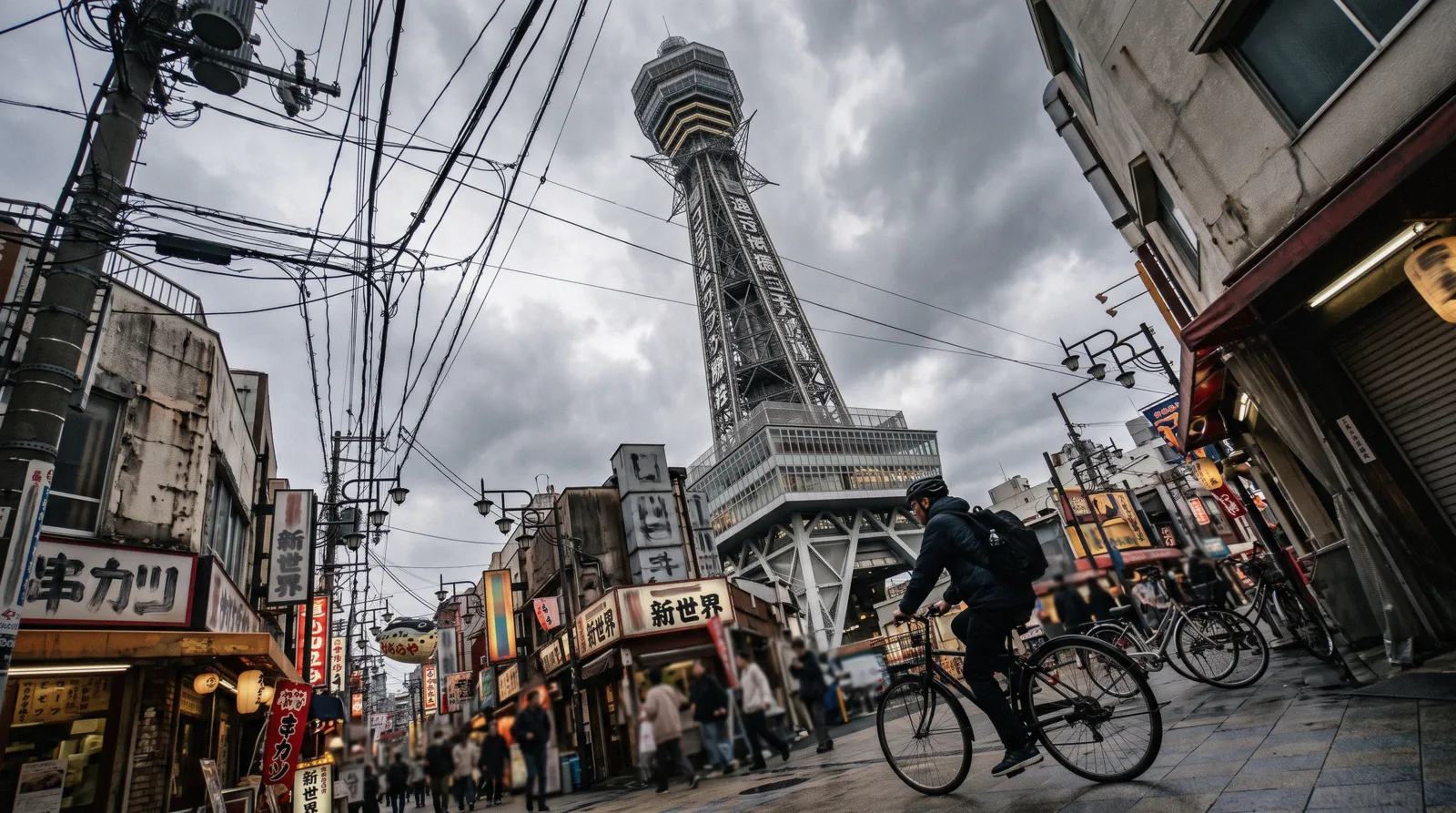
Tsutenkaku
Tsutenkaku is the 108-metre steel tower at the centre of the Shinsekai grid, and everything about visiting it changed with one rule: the tower now runs on timed entry, and every ticket needs a booked slot — including the ones that come free with a city pass. Buy online and you choose an hour. Turn up with an Osaka Amazing Pass and your first job at the tower is to book a time at the counter and then wait for it. The tower also warns that evening slots sell out. That rule, the ¥1,500 set ticket, the slide that runs down the outside and the discount it buys you at the zoo are all below; the rest of the city is covered in our guide to things to do in Osaka.
Quick answer The booking rule, the price, the hours and the slide — in five lines
Tsutenkaku now requires a booked entry time for every ticket, and pass holders must reserve that time at the counter on arrival rather than walking straight in. Admission is $9.41 (¥1,500) for adults and $5.02 (¥800) for children aged 5 to 14, sold only as a set of the general deck and the special outdoor deck. The tower is open 09:00 to 21:45, last admission 21:15 for the general deck and 21:35 for the outdoor one. From the tower's own operating page; dollar figures on this page use the European Central Bank rate of ¥1,000 to $6.27, read the same day.
Key takeaways
- Book a slot before you travel. The tower says outright that tickets can sell out in the evening, and its all-in experience ticket is a timed booking with free cancellation up to 24 hours before
- The $9.41 (¥1,500) is not a choice — the general deck and the special outdoor deck are sold together and there is no cheaper ticket for one of them
- Holders of the Osaka Amazing Pass, the Osaka e-Pass or any voucher still have to queue at the tower's own counter to be given a time
- The Tower Slider and Dive & Walk are separate from admission and carry their own height, weight and age limits — details in the attractions section below
- Show a same-day Tsutenkaku ticket at Tennoji Zoo and the adult fare drops to $4.51 (¥720) and the child fare to $1.13 (¥180)
Key facts
Opening hours
| General observation deck, daily | 09:00–21:45 |
|---|---|
| General deck, last admission | 09:00–21:15 |
| Special outdoor deck, last admission | 09:00–21:35 |
| Official shop, 2F | 09:00–21:30 |
Closed Not published. The tower states that any change of hours or unscheduled closure is announced on its official X account and nowhere else, so this page does not print "open daily" — check that account on the morning of your visit
Admission
- Adult
- $9.41 (¥1,500), 15 and over — general deck plus special outdoor deck, sold only together
- Reduced
- $5.02 (¥800) age 5 to 14; $8.15 / $4.39 (¥1,300 / ¥700) with a disability certificate, with one companion at the same rate and the second onwards at full price; $8.78 (¥1,400) / $4.39 (¥700) for groups of 10 or more and $8.15 (¥1,300) / $4.39 (¥700) for school groups, both currently suspended
- Free
- Tour leaders escorting a group. A group pre-visit inspection costs $5.02 (¥800) a head for up to three people
Planning it
- Time needed
- Not stated by the operator; our routing: 60 to 75 minutes for the decks, or two hours if you ride the slide
- Book ahead
- Essential — weeks ahead
- Address
- 1-18-6 Ebisuhigashi, Naniwa-ku, Osaka 556-0002 (telephone 06-6641-9555)
Four ways in, priced from the tower's own operating page and from GetYourGuide in Q3 2026. Every one of them, without exception, needs an entry time attached to it — the only question is whether you attach it at home or in a queue at the base of the tower.
Every ticket here carries an entry time, so the question is where you attach it: $9.41 (¥1,500) on the tower's own page, or the platform's experience ticket from $6.87, which cancels free.
| Option | Price | Includes | Cancel | Book |
|---|---|---|---|---|
| Official adult ticket, 15 and overAnyone 15 or over who wants both decks — they are only sold as a set | $9.41 (¥1,500) | General deck and special outdoor deck, as one set | No refund, no reissue, no re-entry once you leave | Official site |
| Official child ticket, ages 5 to 14Children aged 5 to 14, on the same two decks | $5.02 (¥800) | Same two decks | Same terms as the adult ticket | Official site |
| With a disability certificateCertificate holders and one companion — counter only, as online carries no discount | $8.15 / $4.39 (¥1,300 / ¥700) | Same two decks; one companion at the same rate | Counter only — online tickets carry no discount rates | Official site |
| Experience ticket, from deck-only to all-inVisitors who want the Tower Slider or Dive & Walk, or a cancellable booking | Listed from $6.87 | Options up to both decks plus one Tower Slider and one Dive & Walk | Free cancellation up to 24 hours before | Check Availability |
Two things the tower prints that resellers rarely repeat. Group bookings are suspended altogether — parties of ten or more have a published rate of ¥1,400 an adult, but the tower has stopped taking the reservations that go with it and asks groups to queue like everyone else. And the discounted rates cannot be bought online at all: anyone entitled to the disability fare has to buy at the on-site ticket centre and show the original certificate or a photocopy, which the tower explicitly accepts.
Tsutenkaku ticket options compared
The card links to the operator's own page, where the live calendar shows which entry times are still open for your date. The price is the platform's USD listing, and the operator charges in your own currency at checkout.
 from $6.87
Official ticket
from $6.87
Official ticket
Osaka: Tsutenkaku Tower Experience Ticket
Options run from the 87.5-metre general deck up to the all-in ticket with the outdoor deck, the Tower Slider and Dive & Walk. The tower now requires a timed reservation for every ticket, pass holders included, so booking a slot is the point.
Check AvailabilityPrices, ratings and details are the platform's own. Dollar figures are the listed prices. The platform bills in your account's currency.
Tsutenkaku against Osaka's other two decks
Three high views are sold in this city and only one of them makes you book an hour in advance. Prices, hours and booking rules below are from each venue's own site, and heights are the Wikidata figures for each structure.
| Deck | Adult ticket | What you stand on | Hours | Booking and passes |
|---|---|---|---|---|
| Tsutenkaku | $9.41 (¥1,500) | A 108-metre tower; general deck plus a small open outdoor deck above it | 09:00–21:45, last admission 21:15 | Timed reservation for every ticket. Free on the Amazing Pass, but you still book a slot on arrival |
| Umeda Sky Building, Floating Garden | $12.54 (¥2,000) | A 173-metre building; the top level is an open ring around the roof, no glass | 09:30–22:30, last admission 22:00 | No slot, walk up. Amazing Pass free before 15:00 only, 10% off after |
| Abeno Harukas 300 | $12.41 web advance, $13.79 at the counter (¥1,980 / ¥2,200) | A 300-metre tower; glass corridor floor-to-ceiling on 60, open-air atrium on 58 | 09:00–22:00, last admission 21:30 | No slot, one walk-up counter. Not on the Amazing Pass free list |
Read from the Tsutenkaku side the trade is clear: you pay the least, you stand the lowest, and you are the only one of the three who has to plan. Our verdict from this page: Tsutenkaku is not competing on the view and should not be judged on it. At 108 metres you are looking along the streets of Shinsekai rather than across a prefecture, and what you are buying is a tower with a slide down the outside, a golden observation floor, a shrine to a good-luck doll and a basement arcade — an afternoon, not a photograph. For the photograph, pay ¥500 more and take the open roof at Umeda Sky after dark, or ¥480 more for the distance at Abeno Harukas in daylight. If you are doing two of the three, do this one first and eat underneath it.
The booking rule, and what it means at the door
One line on the tower's operating page rewrites every older guide to this attraction: an entry time must be reserved for every ticket purchase.
The tower states it plainly. A reserved entry time is required whenever any ticket is bought, waiting on the day may still happen, and buying the advance online timed ticket is recommended. It then adds the sentence that decides your afternoon: from late in the day onwards tickets can sell out, so come with time to spare.
The consequence for pass holders is the part nobody has updated. Holders of the Osaka Amazing Pass, the Osaka e-Pass, the Tanoshii Kansai Pass and exchange vouchers of any kind are told to reserve an entry time at the counter on site, on the day. The pass is still free entry; it is no longer instant entry. The Amazing Pass's own facility listing repeats it in English — it's required to book a time slot at the facility, please visit with time to spare — which makes this one of the rare cases where the pass operator and the venue agree. What neither publishes is how far ahead the day's slots run out, so the honest advice is to make the tower your first stop of the afternoon rather than your last.
There is a second consequence for anyone entitled to a reduced fare. The tower states that group and disability discounts are not applied to online tickets and must be bought at the on-site ticket centre — so a visitor with a certificate cannot both pre-book a slot online and pay ¥1,300.
So which ticket do you actually buy?
If your date is fixed and you want a specific hour, buy the timed ticket ahead. The tower's own online ticket is the direct route; the experience ticket sold through GetYourGuide is the other, listed from $6.87 for the deck and rising through the options to the all-in version with both decks, one Tower Slider ride and one Dive & Walk, and it carries free cancellation up to 24 hours before, which the tower's own ticket does not.
If you are on an Osaka Amazing Pass, you cannot pre-book, so build the day around it: arrive between opening and mid-morning, take whatever slot the counter gives you, and spend the gap in Shinsekai — which is where you were going to eat anyway. The pass costs $21.90 (¥3,500) for one day and $31.40 (¥5,000) for two, and this tower is one of the few entries on it where the free admission is worth the constraint that comes with it.
What is inside: eight levels, two decks and a slide
The tower is arranged as a route from the basement up and back down, and the ticket covers more of it than most visitors realise.
The two decks are what the ¥1,500 buys, and they are sold together because the tower does not offer them apart. The general observation deck sits inside the tower; the special outdoor deck, branded Tembo Paradise, is above it and open to the weather, along with a projecting platform called TIP THE TSUTENKAKU that pushes out beyond the tower's footprint. The tower warns that the outdoor deck can be closed without notice in bad weather, and unlike a rained-off rooftop elsewhere, here the indoor deck below is still a deck. The English Wikipedia article puts the main observation deck at 91 metres; the ticket product sold by the tower's own reseller describes the general deck at 87.5 metres and the special outdoor deck at 94.5. Nobody's figures quite agree, which is worth knowing before you argue with a sign.
Below the decks the tower fills its floors with things that are included in the same ticket. Floor 5 is the golden observation floor, where Billiken is enshrined — the American charm doll that arrived in Japan around 1910, went into the Luna Park amusement grounds beside the first tower, vanished when the park closed in 1923 and was recreated from an old photograph in 1979. Rubbing the soles of his feet for a wish is the tower's single most-photographed act. Floor 4 is the observation floor of light, floor 3 the top floor, floor 2 the under floor with the official shop, floor 1 holds a reconstruction of the first tower's great painted ceiling, and the basement is Waku Waku Land. The Billiken history is from the English Wikipedia article on the tower; the floor list is the tower's own.
The Tower Slider and Dive & Walk are not in your ticket
Both are separate purchases on top of the observation fee — the tower says so twice on its own page. Their published reference fees, restrictions and seasonal hours come from the Osaka Amazing Pass facility list, which prints them in more detail than the tower's own English pages do.
| Attraction | Reference fee | Hours | Who can ride |
|---|---|---|---|
| Tower Slider | $6.90 (¥1,100) | June 10:00–20:00, last entry 19:30; July to March 09:30–20:30, last entry 20:00 | 120 cm and over, under 120 kg, ages 7 to 65; helmet and slide sack compulsory |
| Dive & Walk | $18.81 (¥3,000) | August 09:10–20:00; September to March 10:10–20:00, last entry 19:15 | 130 cm and over, under 120 kg, ages 9 to 65; harness and helmet, no skirts or dresses, no sandals or heels |
The house rules, which are unusually specific
Tripods are banned outright, along with occupying a spot for photography. Pets are refused; assistance dogs are admitted under the law that took effect on 1 October 2002, and the tower may ask to see the dog's health-management booklet, certification and vaccination record. Broadcasting or streaming the interior without permission is on the prohibited list, as is smoking anywhere in the building — which matters more than it sounds, because Osaka has fined street smoking city-wide at $6.27 (¥1,000) since 27 January 2025 and heated tobacco counts.
And once you leave, that is the end of the ticket: no re-entry, no refund, no reissue.
Why the tower is here at all
The one standing today is the second Tsutenkaku, and the first one is why Shinsekai looks the way it does.
The original tower went up in 1912, modelled on the Eiffel Tower with an Arc de Triomphe beneath it, and was linked by an aerial cable car to Luna Park next door. At 64 metres it was the second-tallest structure in Asia, and it made this corner of Osaka the place everyone came. Fire badly damaged it in 1943; rather than repair it, the authorities dismantled it and gave the steel to the war effort. After the war local residents campaigned to have it back, a private company was formed to do it, and Tachu Naito — the engineer known in Japan as the father of towers — designed the eight-sided replacement that opened in 1956. Wikidata records the present tower's inception as 6 July 1955.
Hitachi has sponsored it since 1957, which is why the sides carry advertising and one face usually carries a public message instead. The neon that made the tower famous has been replaced by LEDs that change colour every two months, and the lamps at the very top are a weather beacon: a colour combination that forecasts the next day. The tower publishes that forecast on its own site alongside the lighting schedule. All of this is from the English Wikipedia article on Tsutenkaku, except the lighting page, which is the tower's own.
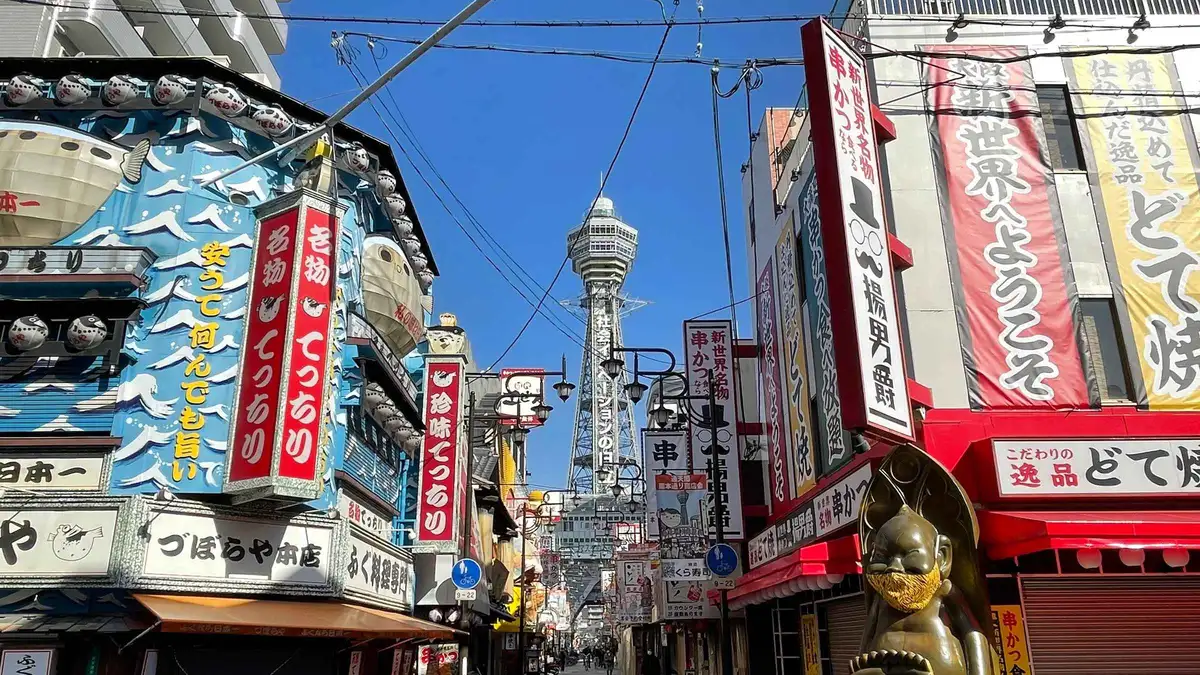
The district around it is the other half of the story. Shinsekai dates from 1903 and the Fifth National Industrial Exposition held on this ground and at Tennoji; the tourism bureau's own page names the tower, the Janjan Yokocho lane and the pufferfish lantern as its landmarks, and counts about fifty establishments along the 130 metres of Janjan Yokocho. Kushikatsu — skewered, crumbed, deep-fried, and governed by the rule that you never dip a skewer twice — is what the bureau calls a representative Osaka dish, concentrated in exactly this area. The Shinsekai page covers the streets; this one covers the tower they point at. For the tower and the streets below it in one outing, the Osaka guided tours that cover this part of the city usually combine Tsutenkaku with Shinsekai.
Getting there, and the discount you get for leaving
Five stations sit within ten minutes, there is no car park, and your used ticket is worth money at the zoo.
The tower publishes its own walking times: three minutes from exit 3 of Ebisucho on the Osaka Metro Sakaisuji Line, three minutes from Ebisucho on the Hankai tram, six minutes from exit 1 of Dobutsuen-mae on the Midosuji Line, six minutes from the Tsutenkaku (east) exit of Shin-Imamiya on the JR Loop Line, and ten minutes from the west exit of Nankai's Shin-Imamiya. Metro fares run $1.19 to $2.45 (¥190 to ¥390) by zone; the getting around Osaka page has the day cards, including the Enjoy Eco Card at $5.14 on a weekday and $3.89 at a weekend (¥820 / ¥620). There is no car or coach parking at the tower and it directs drivers to paid car parks nearby.
One more route worth knowing if you are flying out of Kansai. The tower sells a combined product it calls the Let's Go! Tsutenkaku ticket: a one-way fare between Namba and Kansai Airport station together with the observation ticket for both decks, with one permitted stopover at either Imamiya-Ebisu or Shin-Imamiya. It is the only ticket on this page that solves two problems at once, and the airport transfer page sets it against the alternatives.
The zoo discount, which pays for lunch
Show a same-day Tsutenkaku ticket, paper or online, at Tennoji Zoo and the adult admission drops from $5.02 to $4.51 (¥800 to ¥720) and the child rate to $1.13 (¥180). The zoo publishes the offer on its own page and states that it stays valid to the end of the month after your tower visit, which makes it usable on a later day of the same trip. The zoo runs 09:30 to 17:00 with last admission at 16:00 and closes every Monday, so a Monday tower visit cannot be paired with it — and the walk between the two is under ten minutes through the Tenshiba lawn.
Tsutenkaku map: the tower, the stations and Shinsekai around it
The tower, the two stations three minutes away, and the four things within a short walk that this ticket connects to.
The tower's own pin uses the coordinate it publishes on its access page; the others use each venue's published figure where one exists. Map tiles are OpenStreetMap.
Next stop from Tsutenkaku
Walking times are the venues' own where they publish them and our estimates otherwise.
Shinsekai
The grid the tower stands in, laid out after the 1903 exposition: Janjan Yokocho runs about 130 metres with some fifty places along it, most of them frying skewers.
You are already in itTennoji Zoo
$4.51 (¥720) instead of ¥800 on a same-day tower ticket, valid to the end of the following month. Closed every Monday, last admission 16:00.
9 minutes on footSpa World
The bath complex at the end of the street: $12.54 on a weekday and $16.93 at a weekend with the pool (¥2,000 / ¥2,700), open through the night.
3 minutes on footTsutenkaku questions
Do you have to book Tsutenkaku in advance?
You have to have a booked entry time, which is not the same thing. The tower requires a reserved slot for every ticket purchase and recommends buying the timed online ticket ahead; if you turn up with a pass or a voucher instead, you reserve your time at the counter on the day and wait for it. Evening slots can sell out. The experience ticket is a timed booking with free cancellation up to 24 hours before.
How much is a Tsutenkaku ticket?
$9.41 (¥1,500) for anyone 15 and over and $5.02 (¥800) for ages 5 to 14. That single price covers the general deck and the special outdoor deck, which the tower sells only as a set — there is no cheaper deck-only fare. A disability certificate brings it to $8.15 or $4.39 (¥1,300 or ¥700), with one companion at the same rate, and must be bought at the counter because online tickets carry no discounts.
What time does Tsutenkaku close?
21:45, with last admission at 21:15 for the general deck and 21:35 for the special outdoor deck. It opens at 09:00. The second-floor official shop runs 09:00 to 21:30 and the basement arcade closes at 21:30 with last entry at 21:15. The tower publishes no closed days at all — it says only that any change or unscheduled closure is announced on its official X account.
Is the Tsutenkaku tower slide included in the ticket?
No. The Tower Slider is a separate purchase on top of the observation fee, with a published reference price of $6.90 (¥1,100), and so is Dive & Walk at $18.81 (¥3,000). The slide takes riders from 120 cm and over, under 120 kg, aged 7 to 65, in a slide sack and helmet. The all-in version of the experience ticket bundles one ride of each with both decks.
Is Tsutenkaku worth visiting?
For an afternoon in this part of the city, yes — it is the cheapest of Osaka's three decks, the ticket covers a slide, a golden observation floor and a shrine to a good-luck doll, and it buys a discount at Tennoji Zoo on the way out. As a view it is the weakest of the three at 108 metres: for that, the open roof at Umeda Sky after dark or the 300-metre corridor at Abeno Harukas in daylight are the better spends.
How long should you spend at Tsutenkaku?
The tower publishes no duration. Our routing: 60 to 75 minutes for the two decks and the floors between them, or about two hours if you ride the slide, which has its own queue and its own reservation. Add whatever gap the counter gives you if you arrive on a pass, since the slot you are handed may be an hour or more after you ask for it.
Why is Tsutenkaku famous?
Because it is the second tower on the site and the first one made this district. The 1912 original was modelled on the Eiffel Tower with an Arc de Triomphe beneath it, stood 64 metres tall and was the second-tallest structure in Asia; fire damaged it in 1943 and its steel went to the war effort. Residents campaigned it back, and the eight-sided replacement designed by Tachu Naito opened in 1956. Its LED lighting now doubles as a weather beacon for the following day.
Where Tsutenkaku fits in an Osaka day
It is a lunchtime tower with an afternoon attached, and the booking rule decides the order of everything around it.
Build the day around the slot, not the tower. The sequence that works: arrive in Shinsekai between eleven and midday, take a time at the counter or use the one you booked, eat kushikatsu in Janjan Yokocho while you wait, go up, then walk east through Tenshiba to Tennoji Zoo on the discounted ticket — remembering the zoo is shut on Mondays and stops admitting at 16:00. That is a full afternoon on two tickets and one short walk, and it uses the discount the tower gives you rather than leaving it on the counter.
What does not work is leaving it until the evening, when the tower says its slots can go, and pairing it with a second deck the same day, which buys you the same city twice. If you want one high view and one tower, do this one and take the roof at Umeda Sky on a different night. Our routes place it in an afternoon slot — see Osaka in 2 days and Osaka in 3 days — and the things to do in Osaka hub ranks it against everything else competing for the same hours.
Tsutenkaku on film: the decks, the slide and the streets below
Three walk-throughs, each id copied from our own verified list rather than typed from memory and each checked against YouTube's oEmbed record and its thumbnail. Between them they cover the ride up, the slide down the outside and the district the tower stands in.
Tsutenkaku — A Perfect Day at Osaka's Most Fun-Packed Spot!
Works through the tower floor by floor, which is the part the ticket price actually covers.
Video: Wonderful Japan!Osaka - Tower Slider At Tsutenkaku Tower
Shows the slide from the outside and inside, before you decide whether to pay the extra for it.
Video: Japan ForwardA Walk around SHINSEKAI, Osaka + Tsutenkaku Tower Observation Deck
Puts the observation deck in the context of the streets you will be waiting in for your slot.
Video: Cakes with FacesVideos load from YouTube only when you press play.
Prices, hours and terms are set by the venue or operator and confirmed at checkout.
We may earn a commission if you book through one of our links, at no extra cost to you. Full affiliate disclosure