 Osaka City Guide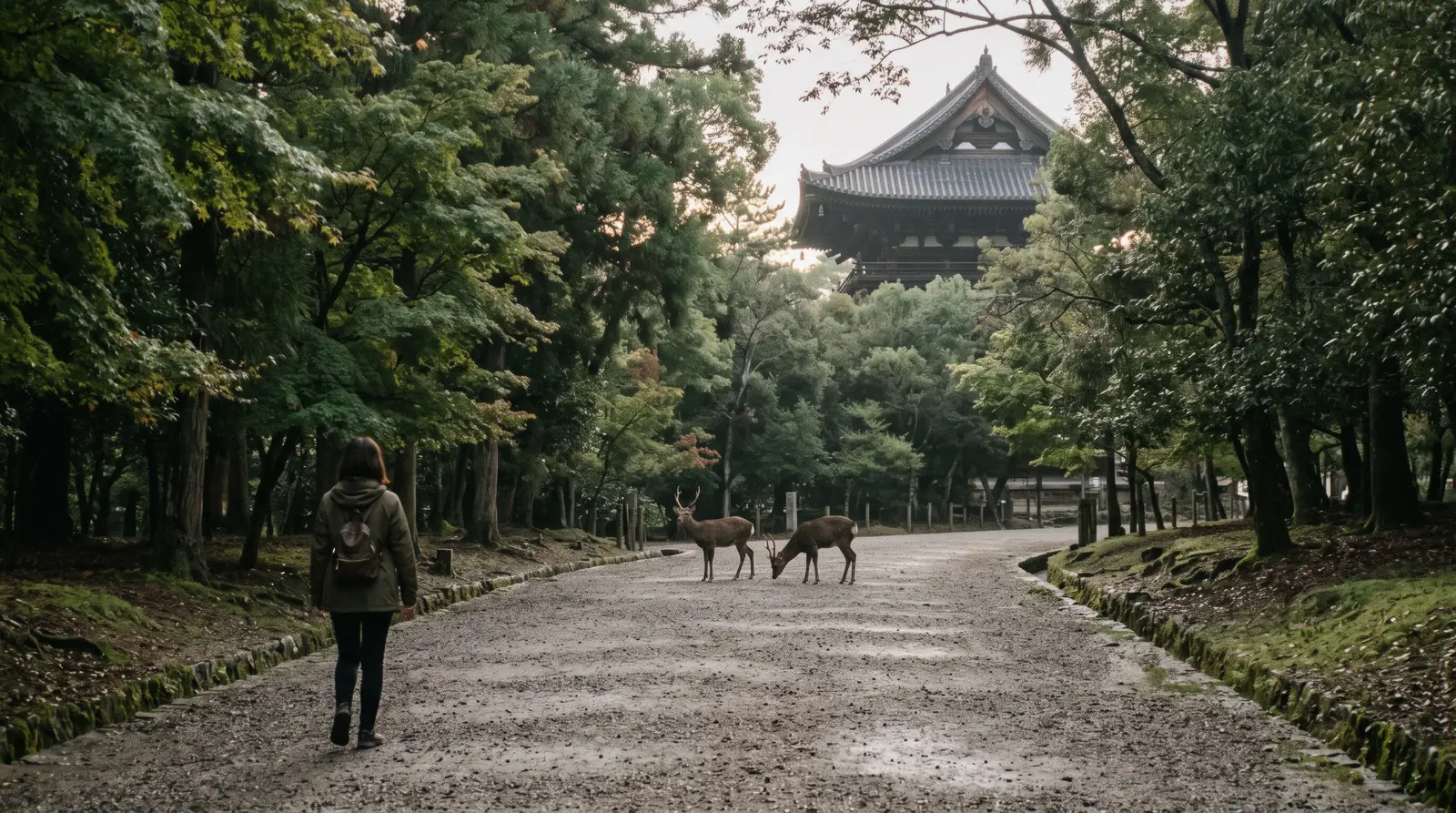
Nara Day Trip From Osaka: 38 Minutes, 1,687 Deer and a ¥260 Trick
A Nara day trip from Osaka is the shortest good excursion in Kansai: 38 minutes on the Kintetsu Express from Osaka-Namba for $4.26 (¥680), and you step out five minutes from a park with 1,687 wild sika deer in it and the largest wooden building most visitors will ever walk into. It is also the trip people most often plan badly, in two specific ways — they leave from the expensive station, and they give it a whole day when it wants a long half. This page prints the four routes with the operators' own fares and times, the deer figures the preservation foundation actually publishes, Todai-ji's admission and hours read from the temple's own page, and the honest verdict on how many hours to spend. Yen figures are the operators' and the temple's own; dollar glosses are approximations at ¥1,000 ≈ $6.27 (European Central Bank reference rate via frankfurter.dev).
Quick answer The cheap station, the fast train, and how many hours Nara actually wants
Yes — and it is the easiest of the four. The Kintetsu Express from Osaka-Namba reaches Kintetsu-Nara in 38 minutes for $4.26 (¥680), and that station is a five-minute walk from the deer park. Nara wants five to seven hours, not a whole day. Fares and times read from JR West's My Dia engine and Kintetsu's own timetable and fare tables.
Key takeaways
- Leave from Namba, not Osaka Station. JR from Osaka Station is $5.27 (¥840); the same railway from JR-Namba is $3.64 (¥580) — $1.63 (¥260) cheaper for the same city, and Kintetsu leaves from Namba too
- Do not pay $3.26 (¥520) for the Kintetsu Limited Express. It saves three minutes over the free Express. That is the clearest bad-value ticket in Kansai, and the operator's own timetable is where the three minutes come from
- Todai-ji is $5.02 (¥800) for adults and $2.51 (¥400) for ages 6 to 12, and the Great Buddha Hall opens 07:30 in summer — earlier than anything in Osaka. Read on the temple's own admission page
- Want the deer, the Great Buddha and a hot spring in one booked day? The Nara and Uji tour includes the Todai-ji admission that the cheaper coaches leave you to pay at the gate
Key facts
Opening hours
| Todai-ji Great Buddha Hall, April to October | 07:30–17:30 |
|---|---|
| Todai-ji Great Buddha Hall, November to March | 08:00–17:00 |
| Todai-ji Hokke-do and Senju-do, all year | 08:30–16:00 |
| Todai-ji Museum, April to October (last entry 17:00) | 09:30–17:30 |
| Nara Park itself | No hours published by the prefecture–— |
Closed Todai-ji lists no closed days on its own admission page, and the prefecture publishes no closing day for Nara Park. The trains run every day.
Admission
- Adult
- Todai-ji Great Buddha Hall, Hokke-do or Kaidan-do $5.02 each (¥800); Great Buddha Hall and the museum together $7.52 (¥1,200); deer crackers $1.25 (¥200)
- Reduced
- Ages 6 to 12 pay $2.51 at Todai-ji (¥400) and $3.76 (¥600) for the hall-and-museum ticket; groups of 30 or more pay $4.39 (¥700) adult, $3.14 (¥500) for ages 16–18, $2.51 (¥400) for 13–15 and $1.25 (¥200) for 6–12
- Free
- Nara Park publishes no admission fee at all, and neither does the walk up to Nigatsu-do above Todai-ji — the view over the city from its balcony costs nothing
Planning it
- Time needed
- Five to seven hours in Nara itself. Out of Osaka at 09:00, back for dinner — it is the one excursion that genuinely works as a half day
- Book ahead
- Optional — walk-up usually fine
- Address
- Kintetsu-Nara Station, Higashimuki-Nakamachi, Nara — five minutes on foot from the western edge of Nara Park
Osaka to Nara: four routes, and a ¥260 gap nobody mentions
Adult one-way fares for weekday midday departures, read from JR West's My Dia fare-and-time engine and Kintetsu's published limited-express fare table and English timetable in Q3 2026.
| Route | Fare | Time | Where it leaves you |
|---|---|---|---|
| Kintetsu Osaka-Namba → Kintetsu-Nara, Express | $4.26 (¥680) | 38 min | Kintetsu-Nara, five minutes' walk from the park's western edge |
| Kintetsu, same route, Limited Express | $4.26 + $3.26 (¥680 + ¥520) | 35 min | The same platform, three minutes earlier |
| JR JR-Namba → Nara, via Tennoji | $3.64 (¥580) | 48 min, one change | JR Nara, about 20 minutes' walk or one bus from the park |
| JR Osaka Station → Nara, Yamatoji Rapid | $5.27 (¥840) | 50 min, no change | JR Nara, same walk — for ¥260 more than JR-Namba |
| Guided coach with hot spring | $57.10 on the platform listing | A full day | Todai-ji, Kasuga Taisha and Uji, with both temple admissions included — the tour |
The last column matters as much as the fare: the two railways arrive at opposite ends of the town, one of them a twenty-minute walk further from the deer. Two things fall out of this table. First, the cheapest ticket and the most convenient arrival are not the same: JR-Namba at ¥580 is the bargain, Kintetsu at ¥680 puts you fifteen minutes closer to the deer, and for most people that $0.63 (¥100) is the best value on the page. Second, the Kintetsu Limited Express supplement buys three minutes for ¥520 — more than three-quarters of the base fare again. Take the Express and spend it on deer crackers.
Nara has no city pass and no combined attraction ticket — you buy rail tickets and temple admissions, each sold at the gate on the day. Everything below is from the operator's or the temple's own page. Converted at ¥1,000 ≈ $6.27.
Nara sells no pass, so the question splits in two: what the rail costs and what each gate costs. Todai-ji's Great Buddha Hall takes $5.02 (¥800) at the door on the day, and a rail pass only pays off beyond a simple return.
| Ticket | Price | What it covers | How you get it | Book |
|---|---|---|---|---|
| Todai-ji Great Buddha HallAnyone who came for the Great Buddha; sold at the gate, with no timed slot | $5.02 adult, $2.51 ages 6–12 (¥800 / ¥400) | The Daibutsuden and the 15-metre bronze Buddha inside it; the same fee separately admits you to Hokke-do or Kaidan-do | At the hall's own gate on the day. No online sale, no timed slot | Official site |
| Great Buddha Hall and Todai-ji Museum togetherVisitors who also want the temple's sculpture collection — it saves ¥400 | $7.52 adult, $3.76 child (¥1,200 / ¥600) | Both the hall and the museum by the Nandaimon gate, which holds the temple's sculpture | Same gate, same day. Saves ¥400 against buying the two separately if the museum interests you | Official site |
| Todai-ji group rate, 30 or moreParties of 30 or more, arranged by the leader on arrival | ¥700 adult, ¥500 ages 16–18, ¥400 ages 13–15, ¥200 ages 6–12 | The same halls, at the group counter | Arranged by the party leader on arrival | Official site |
| Kintetsu Rail Pass, 1 dayOnly a day that keeps moving on Kintetsu; a plain return is ¥1,360 | $11.91 adult, $5.96 child (¥1,900 / ¥950) | Unlimited Kintetsu travel in the Osaka–Nara–Kyoto area for a calendar day | Only worth it beyond a simple return: two Express singles to Nara are ¥1,360 | Official site |
| Kintetsu Rail Pass, 2 dayA trip that pairs this excursion with a second Kintetsu day | $23.20 adult, $11.60 child (¥3,700 / ¥1,850) | The same network across two consecutive days | For a trip that pairs this excursion with a second Kintetsu day | Official site |
| Nara and Uji day trip with hot springOne long day that adds Uji and a hot spring, both temple entries included | $57.10 on the platform listing | Todai-ji, Nara Park, Kasuga Taisha, then Uji for Byodo-in and a soak at Genji no Yu; both temple admissions included | Booked online; free cancellation up to 24 hours before the start time | Check Availability |
The deer crackers are the one purchase you cannot make in advance and should not skip: $1.25 a bundle (¥200), sold from stalls in the park, at a price the Nara Deer Preservation Foundation raised on 1 October 2019 — its first increase in twenty-eight years. They are sold as a licensed product and the vendors are part of the deer-protection arrangement, which is a better reason to buy them than the photographs.
Guided Nara day trips from Osaka
One tour in our catalogue runs this trip as its main event rather than as a stop on a longer loop. It is the version that includes the admissions, which is the line to read before comparing it with the cheaper coaches that pass through Nara on the way to somewhere else. Price and rating are the platform's own.
 from $57.10
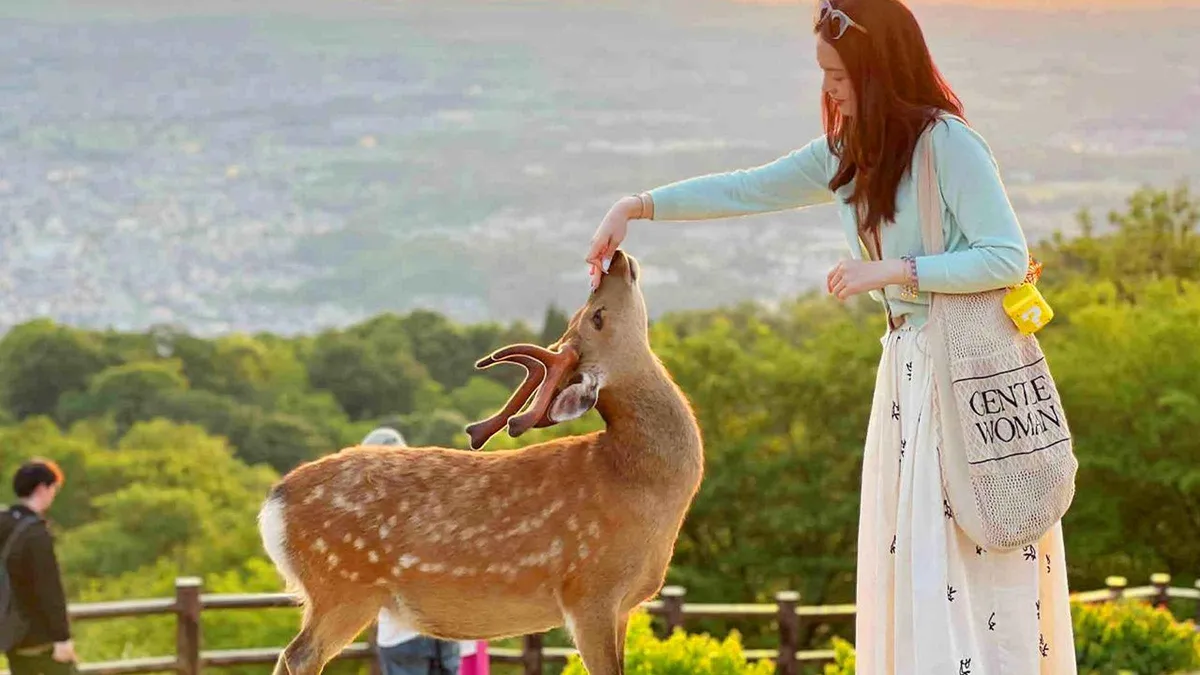
Osaka: Nara and Uji Day Trip with Deer Park and Hot Spring
Nara's Great Buddha and Kasuga Taisha in the morning, then Uji for matcha, Byodo-in and a soak at Genji no Yu. Admission to both temples is included, which the cheaper Nara coaches leave you to pay at each gate.
Check AvailabilityPrices, ratings and details are the platform's own. Dollar figures are the listed prices. The platform bills in your account's currency.
The station choice, and the ¥260 most visitors overpay
Nara has two stations, they are a fifteen-minute walk apart, and only one of them is near anything — the sort of detail our guide to the top places to visit in Osaka exists to print.
Every guide tells you Osaka to Nara costs ¥840 on JR. That is true only if you leave from Osaka Station. The same railway from JR-Namba costs ¥580 — 41.0 kilometres instead of 47.0, one change at Tennoji, and 48 minutes instead of 50. If you are staying anywhere in Namba or Shinsaibashi, which is where most visitors to Osaka sleep, you are two minutes from the cheap version and nobody tells you.
The other railway is the one to take anyway. Kintetsu from Osaka-Namba is ¥680 and 38 minutes, and it arrives at Kintetsu-Nara — a station on the edge of the old town, five minutes on foot from the first deer. JR Nara is a different proposition: a handsome station about twenty minutes' walk west of the park, or one bus ride, and that twenty minutes is at both ends of the day.
So the ranking is not the fare ranking. Kintetsu at ¥680 is the best ticket; JR from JR-Namba at ¥580 is the cheapest if the walk does not bother you; JR from Osaka Station at ¥840 is the one to avoid, because it is the dearest ticket and the further-away station.
The limited express that buys three minutes
Kintetsu runs a Limited Express over the same track, and the supplement is ¥520 on top of the ¥680 fare. It arrives 35 minutes after departure instead of 38.
That is $3.26 (¥520) for three minutes, on a route where the free Express runs several times an hour and the seats are perfectly comfortable. There are places in Japan where a reserved limited express earns its supplement — the Nara run is not one of them. The one real argument for it is a guaranteed seat with luggage on a public holiday, and even then the Express is rarely full leaving Namba.
One more piece of the same arithmetic, for people whose trip is bigger than a day: the Kintetsu Rail Pass is ¥1,900 for one day, and two Express singles to Nara are ¥1,360. The pass only starts making sense when the day includes a second Kintetsu journey, or when it is the 2-day version at ¥3,700 across a genuinely Kintetsu-shaped pair of days.
The deer: the numbers the foundation actually publishes
Nara's deer are a designated natural monument, they are counted every year, and the counting body publishes more than any tourist board does.
The Nara Deer Preservation Foundation surveyed the park over two early mornings, 15 and 16 July 2026, between 05:30 and 08:00, and counted 1,687 deer: 411 stags, 990 does and 286 fawns — 222 more animals than the previous year, with stags up 96 and does up 174 while the fawn count fell by 48. Staff walk fixed routes from a pre-dawn briefing and split large groups between counters; Kasuga Taisha, the prefecture and volunteer groups take part.
That is the figure to carry into the park, because it explains the experience. Around seventeen hundred wild animals live in and around a park a visitor can cross in half an hour, and they are neither tame nor fed by anyone but visitors. They are wild deer that have learned that people carry food.
The crackers — shika senbei — are $1.25 a bundle (¥200), a price set on 1 October 2019, the first rise in twenty-eight years. Buying them is the transaction the whole park runs on, and it is also the moment when the deer stop being scenery: a bundle in your hand attracts several animals at once, and they will nudge, pull at clothing and occasionally butt.
The count itself is worth a sentence, because it is the only hard number anybody publishes about this park. Staff meet at the foundation's office before dawn, walk out to fixed starting points, follow set routes through the park's survey zones and split large groups between counters, then return to compile the totals; Kasuga Taisha, the prefecture and volunteer groups take part. It is done the same way every July, which is what makes the year-on-year movement — 222 more animals than 2025, with fawns down 48 — mean anything at all.
| What is counted | Figure | Change on the year |
|---|---|---|
| Total deer, 15–16 July 2026 survey | 1,687 | +222 |
| Stags | 411 | +96 |
| Does | 990 | +174 |
| Fawns | 286 | −48 |
| Deer crackers | $1.25 a bundle (¥200) | Unchanged since 1 October 2019 |
When the deer are dangerous, and what nobody publishes
The foundation's own public-awareness work names two seasons rather than two hours. Autumn is the rut, when stags are aggressive and unpredictable — the antler-cutting ceremony each October exists precisely because of it. Early summer is the fawning season, when does with young will charge people who get between them. Those are the periods when injuries happen, and they are not the periods most guides warn about.
What nobody publishes is an injury count in any form we could read, and the prefecture's own Nara Park pages carry no admission fee, no opening hour and no closing day — the park is simply open. The famous bowing behaviour is real and is a learned trade for food; it is not published anywhere as a fact about the species, so we describe it as what it is, a habit these particular animals have acquired from decades of visitors.
Practical rules that follow from all of the above: hold the crackers high and hand them over quickly rather than teasing, put paper bags and maps out of reach because the deer will eat both, and do not crouch to a stag's eye level in October.
One more piece of etiquette that follows from the count rather than from folklore: with roughly seventeen hundred animals and a finite number of cracker vendors, the deer nearest the stalls are the pushiest in the park. Walk two minutes east into the open ground below Todai-ji and the same species behaves entirely differently.
Todai-ji, its fees and its early opening
The one building that justifies the journey on its own, with prices and hours from the temple's own admission page.
The Great Buddha Hall is the reason the deer are only half of Nara. Its bronze Buddha sits fifteen metres high inside a wooden hall that is among the largest ever built, and it is one of very few sights in Kansai that visitors reliably describe as bigger than expected.
The fees are simple and are printed by the temple itself: ¥800 for adults and everyone from thirteen to eighteen, ¥400 for ages six to twelve, and the same ¥800 admits you separately to Hokke-do or Kaidan-do. The combined hall-and-museum ticket is ¥1,200 for adults and ¥600 for children — worth it if sculpture interests you, since the museum by the Nandaimon gate holds pieces you cannot see in the hall.
The hours are the useful part for a day-tripper. April to October the hall opens at 07:30 and closes at 17:30; November to March it runs 08:00 to 17:00. Nothing in Osaka opens at half past seven. Hokke-do and Senju-do keep shorter hours, 08:30 to 16:00 all year, and the museum runs 09:30 to 17:30 in summer and 17:00 in winter with last admission half an hour before. The temple lists no closed day at all.
| What | Adult | Ages 6–12 | Hours |
|---|---|---|---|
| Great Buddha Hall (Daibutsuden) | $5.02 (¥800) | $2.51 (¥400) | 07:30–17:30 Apr–Oct; 08:00–17:00 Nov–Mar |
| Hokke-do (Sangatsu-do) | ¥800 | ¥400 | 08:30–16:00 all year |
| Kaidan-do | ¥800 | ¥400 | Published with the same fee band |
| Todai-ji Museum | Included in the ¥1,200 combined ticket | Included in the ¥600 combined | 09:30–17:30 Apr–Oct, 09:30–17:00 Nov–Mar; last entry 30 min before |
| Hall + museum together | $7.52 (¥1,200) | $3.76 (¥600) | As above |
The half-hour above the hall that most people skip
Walk out of the Daibutsuden's east side and up the stone steps rather than back down to the deer. Ten minutes of climbing brings you to Nigatsu-do, a hall on stilts against the hillside with a balcony over the whole Nara basin, and it costs nothing. In the late afternoon it is the best half hour of the day and it is empty compared with everything below it.
From there the path runs south along the hill to Kasuga Taisha, the vermilion shrine whose approach is lined with about three thousand stone lanterns under the trees. The walk between the two is fifteen minutes through woodland with deer in it and no crowds at all, which is not something you can say about the route everyone else takes.
That loop — Kintetsu-Nara, Todai-ji, Nigatsu-do, Kasuga Taisha, back through the park — is the entire day, and it is about five kilometres of gentle walking.
Half a day or a whole one?
The question the search results argue about, answered with the walking times rather than opinions.
Four hours is enough to see Nara badly. You would get from Kintetsu-Nara to the deer, into the Great Buddha Hall, and back to the train, and you would leave out everything above the hall — which is the part people remember.
Five to seven hours is right. That is a 09:00 departure from Namba, in the park by 09:45, Todai-ji before the coaches build at eleven, Nigatsu-do and Kasuga Taisha in the early afternoon, an hour in the Naramachi lanes south of the park, and back in Osaka in time for dinner. Nara has no evening to speak of — the town closes early and the good eating is in Osaka — so a late finish buys you nothing.
A full day is too much unless you add Uji or Horyu-ji. This is where Nara differs from the Kyoto trip, which cannot be finished in a day. Nara can, comfortably, and stretching it turns a good excursion into a slow one.
| Time in Nara | What it holds | Verdict |
|---|---|---|
| 3–4 hours | Deer, Great Buddha Hall, the walk back | The version people regret. Fine if the day already has something else in it |
| 5–7 hours | The above plus Nigatsu-do, Kasuga Taisha and Naramachi | What we would book — the loop is about 5 km on flat and gentle ground |
| A full day | All of the above plus Uji, Horyu-ji or the National Museum | Only with a second target. Nara alone does not fill twelve hours |
| A guided day | Todai-ji and Kasuga Taisha, then Uji and a hot spring | The Nara and Uji tour — the shape that justifies a full day |
What the day costs
Two adults, no tour, the five-to-seven-hour shape. Kintetsu return from Osaka-Namba is $8.53 each (¥1,360). Todai-ji's Great Buddha Hall is ¥800, or ¥1,200 with the museum. Deer crackers are ¥200. Lunch in Naramachi runs to roughly ¥1,200 to ¥2,000, which is our estimate rather than anyone's published figure.
That lands the day at about $22.60 to $30.10 a head (¥3,600 to ¥4,800) — the cheapest of the main excursions from Osaka once Himeji's ¥2,500 castle ticket and Kyoto's local transport are in the comparison. Note what is not on the list: there is no park admission, because nobody charges one, and no city pass, because Nara does not sell a useful one.
The guided alternative is $57.10, and it includes both temple admissions and a hot-spring soak in Uji. Against ¥3,600 of doing it yourself, the coach is buying you Uji, Byodo-in and the onsen rather than saving you money — which is a fair trade if the tea town appeals, and a poor one if what you came for is the deer.
Nara day trip map: the two stations and the walking loop
The whole excursion fits inside this frame. Coordinates are Wikidata's; the walking times are our own measurements of the routes described above.
The gap between the two blue pins is the fifteen-minute walk that decides your railway: Kintetsu-Nara sits inside the town, JR Nara sits west of it. Everything gold on this map is within a 5 km loop on flat or gently rising ground.
What pairs with a Nara day, and what does not
Nara is the excursion with hours left over, which makes the question of what else to put in the day a real one.
Day trips from Osaka
Where this trip sits against Kyoto, Kobe, Himeji, the Minoh waterfall trail and Koyasan — with the fares for each and the verdict on which need a whole day.
All six, comparedKyoto day trip
The excursion most people try to combine with this one. The coaches do it in a day; by train it means crossing two prefectures and shortchanging both.
29 minutes the other wayOsaka in 1 day
If Nara took the morning and half the afternoon, this is the routing that fills the evening without another long ride.
The day you come back toNara day trip from Osaka: questions
Is Nara worth a day trip from Osaka?
Yes, and it is the excursion with the best ratio of effort to reward: 38 minutes and $4.26 (¥680) each way on Kintetsu, no change, and the first deer are five minutes from the platform. You get 1,687 wild deer, the Great Buddha Hall at ¥800, a lantern shrine and a hillside viewpoint that costs nothing, all inside a five-kilometre walking loop. If any of the short trips from Osaka is unmissable, it is this one.
Is four hours in Nara enough?
Enough for the deer and the Great Buddha Hall, and not enough for the part above it. Four hours means skipping Nigatsu-do, whose balcony over the basin is free, and Kasuga Taisha, fifteen minutes along the hillside through woodland. Five to seven hours in Nara — a 09:00 departure from Namba, back in Osaka for dinner — is what we would allow. The timing table is above.
What is the cheapest way to get from Osaka to Nara?
JR from JR-Namba at $3.64 (¥580), one change at Tennoji, 48 minutes — ¥260 cheaper than the same railway from Osaka Station, which is ¥840. But the ticket we would actually buy is Kintetsu from Osaka-Namba at ¥680: ¥100 more, ten minutes faster, and it arrives fifteen minutes' walk closer to the deer. Fares from JR West's My Dia engine and Kintetsu's own tables.
Should you get off at JR Nara or Kintetsu-Nara?
Kintetsu-Nara, unless price is the only consideration. It sits at the edge of the old town, five minutes on foot from the western end of the park; JR Nara is about twenty minutes' walk west of the same spot, or one bus, and you pay that twenty minutes twice. The two stations are roughly fifteen minutes apart on foot — both are on the map.
How much are the deer crackers, and are the deer safe?
$1.25 a bundle (¥200) — a price the Nara Deer Preservation Foundation set on 1 October 2019, its first rise in twenty-eight years. The deer are wild animals, not a petting zoo: the foundation's own awareness campaigns name the autumn rut, when stags are aggressive, and the early-summer fawning season, when does defend their young, as the dangerous periods. Hand crackers over quickly rather than teasing, and keep paper out of reach. No authority publishes an injury count we could find.
Do you need to book Todai-ji in advance?
No. Todai-ji sells at its own gate on the day, with no online ticket and no timed slot: ¥800 for adults and everyone thirteen and over, ¥400 for ages six to twelve, or ¥1,200 and ¥600 for the hall-and-museum combination. Nara Park itself publishes no admission fee and no opening hours at all. The only bookable item on this trip is a guided tour — the Nara and Uji day is the one that includes the temple admissions.
Can you do Nara from Osaka in the same day as somewhere else?
By coach, yes — the guided loops pair the deer park with stops over the prefectural border and run nine to eleven hours. By train it is a poor idea: Nara sits east of Osaka and everything else worth a day sits north or west, so combining means two long rides and half a visit to each. If your trip has the days, give Nara its own morning and afternoon and take a separate one for the other excursions.
Where a Nara day fits in an Osaka trip
First excursion, ideally — it is the gentlest and the most forgiving of a slow start.
Nara is the trip to take on the day after you arrive. The railway is one seat from Namba, the walking is flat, nothing is timed and nothing is bookable, so a late breakfast costs you nothing. Compare that with Kyoto, which punishes a 10:00 start, or Himeji, where an hour of queueing in peak season is the castle's own published warning.
It also leaves the evening intact, which matters more than it sounds. Back at Namba by six, you are three minutes from the Dotonbori canal and the food that is the actual reason to base a Kansai trip in this city. Nara has no dinner scene to speak of and makes no claim to one.
One planning note if your trip is short. Nara and Kyoto both point away from Osaka in different directions, and both are sold as day trips by every coach operator in the city. If you only have room for one, take Nara when you want a day that finishes well and Kyoto when you are prepared for a long one — the whole comparison is on the day-trips hub, and our guide to things to do in Osaka lays out how many days Osaka itself deserves before you start spending them elsewhere.
A Nara day trip on film
Three films we checked ourselves — each id verified against YouTube's own record and its thumbnail, so none is a dead player. Between them they cover the route from Osaka, the walking loop through the park and what the deer are actually like at close range.
Ultimate Day Trip to Nara, Japan | Day Trip from Osaka
The trip this page plans, filmed from the Osaka platform to the park and back.
Video: The City GuruThe Perfect Day Trip to Nara Park | One Day Itinerary
A one-day routing through the park that matches the five-to-seven-hour shape above.
Video: The Navigatio JapanA Day In Nara — How To Reach, Deer Park, Historical Temples, Matcha, Food, and More
The practical version: getting there, the temples, and what eating in Nara is really like.
Video: Wandering MindsVideos load from YouTube only when you press play.
Prices, hours and terms are set by the venue or operator and confirmed at checkout.
We may earn a commission if you book through one of our links, at no extra cost to you. Full affiliate disclosure